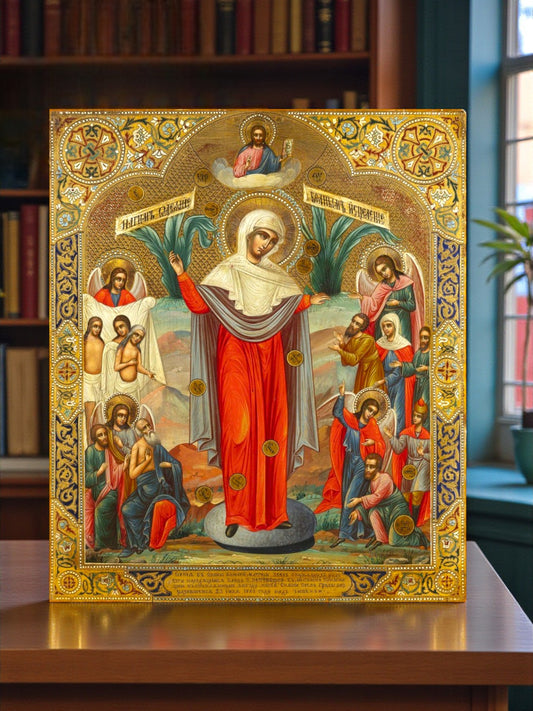
Saint Martin of Braga — Apostle of the Suevi Orthodox Icon
Saint Martin of Braga, also known as Saint Martin of Dume, São Martinho de Braga, São Martinho de Dume, Martin of Dumium, and Martinus Bracarensis, was one of the most important Christian bishops, missionaries and monastic founders of the Iberian Peninsula in the 6th century.
Born in Pannonia around AD 520, Saint Martin travelled to the Holy Land, where he encountered the monastic traditions of the Christian East. Around 550 he came to Gallaecia, in the northwest of the Iberian Peninsula, and eventually settled near Braga in present-day Portugal.
There he became a leading figure in the conversion of the Suevi from Arianism to Nicene Christianity, founded monasteries, strengthened Christian education and ecclesiastical life, and became Metropolitan Bishop of Braga.
For his missionary work he became known as the “Apostle of the Suevi.”
Who Was Saint Martin of Braga?
Martin was born in the Roman province of Pannonia, in Central Europe, traditionally around the year 520.
As a young man he travelled to the Holy Land, where he became a monk. His encounter with Eastern monasticism would have a profound influence on his later life and writings.
Around AD 550, Martin travelled west to the Iberian Peninsula and settled in Gallaecia, a territory encompassing modern Galicia in Spain and parts of northern Portugal.
At the time, the region was ruled by the Suevic Kingdom. Many of the Suevi had embraced Arian Christianity, while older pagan customs also survived among the population.
Martin would become one of the central figures in the transformation of the religious life of the kingdom.
Saint Martin of Dume
Near the Suevic capital of Braga, Martin established the important monastery of Dumium, today Dume, just outside Braga.
The monastery became a center of monastic life, Christian learning and missionary activity.
Martin first served as its abbot and subsequently became Bishop of Dumium, which explains another of his traditional names:
Saint Martin of Dume — São Martinho de Dume.
He participated as Bishop of Dumium in the First Council of Braga in 561. Later he became Metropolitan Bishop of Braga and presided over the Second Council of Braga in 572.
Apostle of the Suevi
Saint Martin is traditionally remembered as the Apostle of the Suevi.
His missionary activity took place during the gradual abandonment of Arianism within the Suevic kingdom and the establishment of Nicene Christianity.
Martin did much more than preach.
He helped organize ecclesiastical life, founded monasteries, worked for the education of clergy and participated in councils that shaped the Christian life of Gallaecia.
His knowledge of both Eastern and Western Christian traditions made him particularly important in the development of the Church in the region.
Saint Martin and the Monastic Tradition of the Christian East
One of the most fascinating aspects of Saint Martin's life is his connection with Eastern Christian monasticism.
Martin knew Greek as well as Latin and brought important elements of Eastern monastic literature to the Iberian Peninsula.
He translated a collection of the Sayings of the Egyptian Desert Fathers from Greek into Latin. Another larger collection was translated by the monk Paschasius of Dumium at Martin's request.
Through this work, the spirituality of the Desert Fathers became part of the Christian and monastic culture developing around Braga and Dume.
This connection makes Saint Martin particularly interesting within Orthodox tradition: although he lived in the far West, his spiritual formation was deeply connected with the Christian East.
Saint Martin of Braga and the Councils of Braga
Martin played an important role in the ecclesiastical councils of his time.
As Bishop of Dumium, he participated in the First Council of Braga in 561.
After becoming Metropolitan of Braga, he presided over the Second Council of Braga in 572.
He also assembled a collection traditionally known as the Canons of Saint Martin, incorporating material translated from Greek and Eastern canonical traditions for use by the Church in the Suevic kingdom.
These activities demonstrate that Martin was not simply a missionary preacher. He was also an important church organizer, theologian, translator and scholar.
The Writings of Saint Martin of Braga
Saint Martin was one of the notable Latin Christian writers of his century.
Among the works associated with him are:
Formula Vitae Honestae — Formula for an Honest Life
A moral treatise dealing with the cardinal virtues.
De Ira — On Anger
A work examining anger and the cultivation of self-control.
De Correctione Rusticorum — On the Reform of the Rural People
A pastoral text addressing surviving pagan beliefs and practices among the rural population.
Pro Repellenda Iactantia — On Driving Away Vanity
De Superbia — On Pride
Exhortatio Humilitatis — Exhortation to Humility
He also translated teachings of the Egyptian Desert Fathers and worked with Eastern ecclesiastical canons.
His writings reveal a remarkable combination of classical education, Christian theology, monastic spirituality and practical pastoral care.
Is Saint Martin of Braga an Orthodox Saint?
Yes. Saint Martin of Braga lived centuries before the Great Schism of 1054 and is commemorated within the Eastern Orthodox tradition.
Orthodox calendars commemorate Saint Martin of Braga on March 20, describing him as a 6th-century bishop and missionary in Iberia.
His life is particularly interesting from an Orthodox perspective because of his close connection with the Holy Land, Eastern monasticism, the Desert Fathers and Greek Christian literature.
He belongs to the shared Christian heritage of the Iberian Peninsula before the division between Eastern and Western Christianity.
Saint Martin of Braga or Saint Martin of Tours?
Saint Martin of Braga should not be confused with Saint Martin of Tours, the famous 4th-century bishop of Tours.
Martin of Braga had great devotion to the earlier Saint Martin of Tours, but they are two different saints.
Saint Martin of Tours lived approximately 316–397 and was Bishop of Tours in Gaul.
Saint Martin of Braga lived approximately 520–580 and became Bishop and Metropolitan of Braga in Gallaecia.
This distinction is especially useful because both saints had an important influence on Western European Christianity.
What Are the Other Names of Saint Martin of Braga?
The saint appears under several names depending on language and historical tradition:
Saint Martin of Braga
St Martin of Braga
Saint Martin of Dume
Martin of Dumium
Martin of Bracara
Martinus Bracarensis
Martinus Dumiensis
São Martinho de Braga
São Martinho de Dume
São Martinho Dumiense
San Martín de Braga
Martín de Braga
In Portugal, São Martinho de Dume and São Martinho de Braga are particularly important forms of his name.
A Rare Icon of an Early Saint of Portugal
Saint Martin of Braga is an especially meaningful saint for Christians connected with Portugal, Braga and Galicia, as well as for those interested in the ancient Orthodox saints of Western Europe.
His life unites several Christian worlds: he was born in Central Europe, encountered monastic Christianity in the Holy Land, brought the wisdom of the Eastern Desert Fathers westward and eventually became one of the great bishops of the Iberian Peninsula.
His icon may be chosen for a home prayer corner, as a Christian gift for someone named Martin or Martinho, or as part of a collection dedicated to pre-Schism Western Orthodox saints.
Our icon is carefully reproduced on a prepared wooden panel and individually hand-finished with natural beeswax in our family workshop in Portugal.
Feast Day: March 20.
FAQ
Who was Saint Martin of Braga?
Saint Martin of Braga was a 6th-century monk, missionary, theologian and bishop who became Metropolitan of Braga and played an important role in the Christianization of the Suevic Kingdom.
Why is Saint Martin of Braga called the Apostle of the Suevi?
He is remembered for his major role in bringing the Suevi from Arianism into Nicene Christianity and strengthening the Church in Gallaecia.
Is Saint Martin of Braga an Orthodox saint?
Yes. He lived in the 6th century, long before the Great Schism, and is commemorated in the Eastern Orthodox tradition on March 20.
Where was Saint Martin of Braga bishop?
He first became Bishop of Dumium, modern Dume near Braga, and later Metropolitan Bishop of Braga.
Are Saint Martin of Braga and Saint Martin of Tours the same person?
No. Saint Martin of Tours lived in the 4th century. Saint Martin of Braga lived in the 6th century and carried out his principal missionary work in Gallaecia.
What is Saint Martin of Braga known for writing?
His surviving works include Formula Vitae Honestae, De Ira and De Correctione Rusticorum, as well as translations connected with the Egyptian Desert Fathers.
🖼 Product Features
Each icon in our workshop is made to last a lifetime and beyond. The image is printed with rich, fade-resistant pigment inks on a premium solid-core wood panel — then hand-finished with a natural beeswax coating that deepens the colors, protects the surface, and gives each piece the warm, reverent quality of a traditionally crafted sacred object. A metal hanging hook is included on the back, so your icon is ready to display the moment it arrives.
- Crafted on a premium wood panel — 1.6 cm (0.6") thick, sturdy yet lightweight
- Fade-resistant pigment print — rich, true-to-life colors that last for generations
- Natural beeswax finish — hand-applied for depth, protection, and a traditional feel
- Ready to hang — metal hook pre-attached on the reverse
- Hand-finished by Orthodox Christian artisans in Portugal
📏 Available Sizes
• Small – 12 x 15 cm (5” x 6”)
• Medium – 23 x 30 cm (9” x 12”)
• Large – 30 x 39 cm (12” x 15”)
🎁 Perfect For
• Meaningful Orthodox Christian gifts
• Housewarming and family blessings
• Prayer corners and devotional spaces
• Baptisms, name days, weddings, and feast days
🌍 Worldwide Delivery
Securely packed and shipped worldwide from Portugal with tracking.
✨ Crafted with Tradition
Each icon is carefully made by Orthodox Christian artisans in Portugal — created to become a lasting blessing for your home or a treasured gift for someone you love.