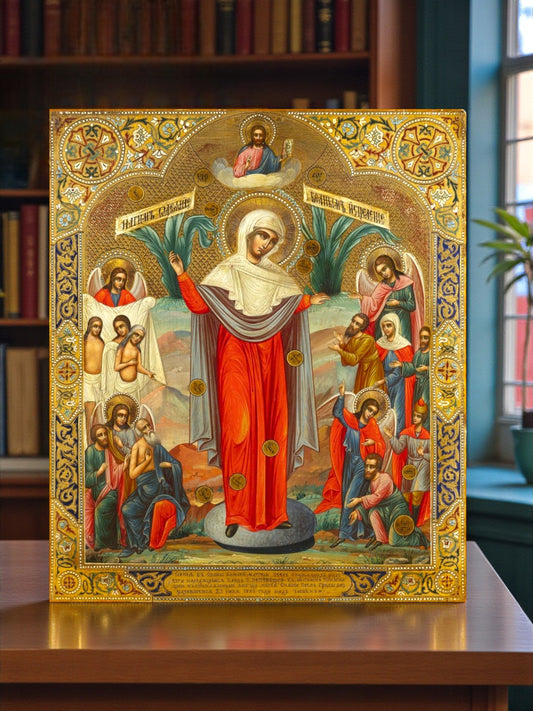
Christ the True Vine with the Twelve Apostles — 16th-Century Greek Orthodox Icon
Christ the True Vine with the Twelve Apostles, also known as Christ the Vine or Christ Ampelos, is a remarkable Byzantine and post-Byzantine iconographic composition inspired by the words of Jesus Christ in the Gospel of John:
“I am the true vine, and my Father is the husbandman.” — John 15:1 (KJV)
This rare icon reproduces a 16th-century Greek composition associated with the Byzantine Museum in Athens, Greece, originally executed in egg tempera on a wooden panel.
Unlike images in which Christ simply holds a grapevine, this composition presents the entire Church as a living vine. Christ sits at its center, while the Twelve Apostles rest upon the branches growing from Him.
The image expresses one of the central teachings of Christianity: Christ is the source of life, and the Church remains spiritually alive through its union with Him.
Christ the True Vine as the Tree of Life
The icon Christ the True Vine with the Twelve Apostles is also sometimes described as Christ the Tree of Life, emphasizing its symbolism of divine life, spiritual growth and the unity of the Church.
At the center of the composition, Christ is seated within a great vine whose branches support the Twelve Apostles. The image recalls His words in John 15:5: “I am the vine, ye are the branches.”
The Tree of Life is a biblical symbol appearing in the Book of Genesis (Genesis 2:9) and the Book of Revelation (Revelation 22:2). In Christian theology, Christ is understood as the source of eternal life, fulfilling the promise of life restored through communion with God.
Although the Tree of Life and Christ the True Vine are distinct biblical images, they share a profound theological connection: life comes from God, and humanity is called to remain united with Him.
The apostles seated among the branches represent the Church, nourished by Christ and called to bear spiritual fruit. The grapes evoke the Eucharist, while the living vine expresses the enduring unity of the faithful in Christ.
Iconography — Christ and the Twelve Apostles
At the center of the icon, Jesus Christ is seated upon the trunk of a great grapevine, wearing reddish garments and holding an open Gospel Book.
His arms extend outward in a gesture that visually embraces the branches and the apostles seated upon them.
The open book recalls Christ's teaching in John 15, particularly His declaration that He is the True Vine and His disciples are the branches.
Twelve apostles appear among the vine's intertwining branches, arranged on either side of the Savior. They hold books or scrolls, symbols of their apostolic teaching and proclamation of the Gospel.
The apostles are connected to Christ through the same living vine. Their positions emphasize that, although each apostle has a distinct mission, all receive their spiritual life from the same Lord.
The branches bear dark grape clusters and abundant leaves, representing spiritual fruitfulness and the continuation of Christian faith.
The warm golden background, intricate vine branches and expressive figures are characteristic of the richly symbolic language of post-Byzantine icon painting.
“I Am the Vine, You Are the Branches” — John 15:1–8
The icon illustrates Christ's teaching during His farewell discourse to the disciples:
“I am the vine, ye are the branches: He that abideth in me, and I in him, the same bringeth forth much fruit: for without me ye can do nothing.” — John 15:5 (KJV)
The vine is an image of spiritual communion.
Christ is the source of divine life. The apostles, represented as branches, are united to Him and carry His teaching into the world.
The grapes symbolize the fruits of a life rooted in Christ: faith, love, holiness, perseverance and good works.
This icon reminds Christians that spiritual fruitfulness does not arise from human effort alone. It comes from remaining united with Christ through faith, prayer, love and the life of the Church.
The True Vine as an Image of the Church
One of the most important meanings of this icon is the unity of the Church in Christ.
The apostles are shown as individual figures, yet all are supported by a single trunk.
Their common source is not an institution, a geographical place or an individual apostle, but Jesus Christ Himself.
The composition presents the Church as a living spiritual organism, sustained by Christ and called to bear fruit through love.
It also recalls the apostolic mission: the Gospel is carried into the world through the disciples, while its life and authority remain rooted in the Savior.
Saint Peter, Saint Paul and the Unity of Christians
In interpretations of the Christ the Vine composition, the prominent positions of Saint Peter and Saint Paul have been understood as a possible reference to the unity of Eastern and Western Christianity.
The iconographic theme became especially significant in the Cretan artistic tradition during the fifteenth century, when the relationship between the Eastern and Western Churches was a major concern.
The Council of Ferrara–Florence (1438–1439) attempted to restore ecclesiastical union between East and West.
Scholars have suggested that certain Cretan versions of Christ the Vine may reflect these concerns through their emphasis on the common foundation of apostolic Christianity.
This interpretation is one possible historical reading of the composition, rather than its only meaning.
Above all, the icon proclaims the biblical truth that all Christians are called to remain united in Christ.
The Grapevine and the Holy Eucharist
The grapes also recall the mystery of the Holy Eucharist.
In Orthodox Christian worship, bread and wine become the Body and Blood of Christ.
The grapevine therefore carries a second layer of meaning: it points toward the spiritual nourishment received through communion with the Savior.
The apostles gathered upon the vine can be understood as an image of the Church sharing one divine life.
The vine and its fruit unite the themes of Christ's sacrifice, the Eucharist, apostolic fellowship and spiritual transformation.
Christ the Vine and the Tree of Jesse
The composition also has visual connections with the Tree of Jesse, another important subject in Christian sacred art.
The Tree of Jesse represents the ancestry of Jesus Christ, traditionally beginning with Jesse, the father of King David, and extending through the generations leading to the Incarnation.
While the Tree of Jesse emphasizes Christ's earthly ancestry and the fulfillment of Old Testament prophecy, Christ the True Vine emphasizes the spiritual life of the Church flowing from Christ.
The visual resemblance between the two compositions suggests a profound continuity between the Old and New Testaments.
Christ fulfills the promises given to Israel and becomes the source of life for His Church.
Historical Background — Greek Icon Painting and the Cretan Tradition
The iconographic subject Christ the Vine became particularly important in late Byzantine and post-Byzantine painting.
A celebrated fifteenth-century version was created by the Cretan icon painter Angelos Akotantos (d. 1450).
His composition helped establish a recognizable artistic model in which Christ is seated within the vine, surrounded by the apostles.
The 16th-century Greek icon associated with the Byzantine Museum in Athens belongs to this wider iconographic tradition.
It should be distinguished from the earlier work of Angelos Akotantos: the Athens composition is a separate historical example of the same subject, not an original painting by Angelos.
Its elaborate branches, golden ground, seated apostles and central figure of Christ reflect the theological and artistic sophistication of post-Byzantine icon painting.
Why Keep the Christ the True Vine Icon?
This icon is particularly meaningful for Christians who wish to contemplate the unity of the Church, the apostolic faith and the spiritual life received through Christ.
It serves as a reminder:
-
That Christ is the foundation and source of the Church's life.
-
That Christians are called to remain united in Him.
-
That spiritual growth bears fruit through faith, love and obedience to God.
-
That the Twelve Apostles carried Christ's teaching into the world.
-
That Holy Communion nourishes the life of the Church.
-
That Christian unity requires humility, faithfulness and sacrificial love.
The icon is suitable for a home prayer corner, church, monastery, theological library or a collection of historic Byzantine sacred art.
This icon is especially meaningful for those devoted to Christ the True Vine, the Twelve Apostles, Byzantine iconography and the Christian theology of the Church.
Frequently Asked Questions
What does Christ the True Vine with the Apostles represent?
The icon represents Christ as the source of spiritual life and the Twelve Apostles as branches of the same vine, illustrating John 15:1–8.
Why are the apostles sitting on the branches?
The branches symbolize their spiritual union with Christ. Although the apostles have different missions, all receive their life and teaching from Him.
What do the grapes symbolize?
The grapes represent spiritual fruitfulness and also recall the Eucharist, especially the wine associated with the Blood of Christ.
Is this the same as an icon of Christ holding grapes?
No. Both draw upon the biblical image of the True Vine, but this composition specifically depicts Christ seated within a large vine surrounded by the Twelve Apostles.
Where does this icon come from?
The reproduced composition is associated with a 16th-century Greek icon in the Byzantine Museum in Athens, Greece.
Did Angelos Akotantos paint this particular icon?
No attribution to Angelos Akotantos is made for this 16th-century example. He painted an important earlier version of the same iconographic subject in the fifteenth century.
What is the biblical source of this icon?
The principal passage is John 15:1–8, especially Christ's words: “I am the vine, ye are the branches.”
Is this an antique or hand-painted icon?
No. This is a contemporary wooden reproduction of a historical Greek icon, produced using detailed pigment printing and individually finished by hand in Portugal.
🖼 Product Features
Each icon in our workshop is made to last a lifetime and beyond. The image is printed with rich, fade-resistant pigment inks on a premium solid-core wood panel — then hand-finished with a natural beeswax coating that deepens the colors, protects the surface, and gives each piece the warm, reverent quality of a traditionally crafted sacred object. A metal hanging hook is included on the back, so your icon is ready to display the moment it arrives.
- Crafted on a premium wood panel — 1.6 cm (0.6") thick, sturdy yet lightweight
- Fade-resistant pigment print — rich, true-to-life colors that last for generations
- Natural beeswax finish — hand-applied for depth, protection, and a traditional feel
- Ready to hang — metal hook pre-attached on the reverse
- Hand-finished by Orthodox Christian artisans in Portugal
📏 Available Sizes
• Small – 12 x 15 cm (5” x 6”)
• Medium – 23 x 30 cm (9” x 12”)
• Large – 30 x 39 cm (12” x 15”)
🎁 Perfect For
• Meaningful Orthodox Christian gifts
• Housewarming and family blessings
• Prayer corners and devotional spaces
• Baptisms, name days, weddings, and feast days
🌍 Worldwide Delivery
Securely packed and shipped worldwide from Portugal with tracking.
✨ Crafted with Tradition
Each icon is carefully made by Orthodox Christian artisans in Portugal — created to become a lasting blessing for your home or a treasured gift for someone you love.