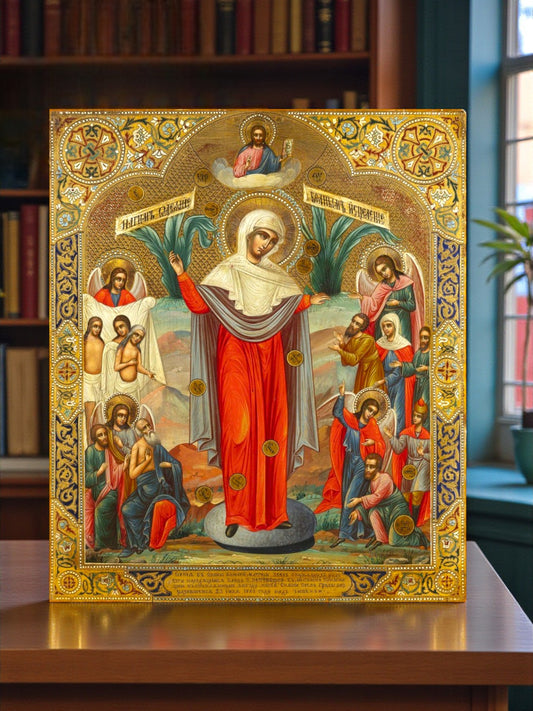
Saint Isidore of Seville — Orthodox Icon
Saint Isidore of Seville, also known as Isidore of Seville and Isidore of Hispalis, was one of the greatest bishops, scholars and Christian writers of Visigothic Spain.
Born in the 6th century and serving as Archbishop of Seville for more than three decades, Saint Isidore devoted his life to the defense of the Christian faith, the education of clergy and the preservation of learning during a period of profound transformation in Western Europe.
He is particularly famous as the author of the Etymologiae (Etymologies), an extraordinary encyclopedia that attempted to gather and organize the knowledge of the ancient world for future generations.
Saint Isidore died in 636, centuries before the Great Schism, and belongs to the common heritage of the ancient Christian Church. He is honored among the Western Orthodox saints and represents the rich Christian tradition of early medieval Spain.
Who Was Saint Isidore of Seville?
Saint Isidore was born around AD 560 in Hispania, probably in or near Cartagena, into an influential Hispano-Roman family.
His family produced several saints of the early Spanish Church. His elder brother Saint Leander of Seville preceded him as bishop of Seville, while his siblings Saint Fulgentius and Saint Florentina were also remembered for their service to the Church.
After the death of Saint Leander, Isidore succeeded him as Bishop of Seville, traditionally dated to around the year 600.
He remained bishop until his death in 636.
Saint Isidore and Visigothic Spain
Isidore lived during one of the most important periods in the religious history of the Iberian Peninsula.
The Visigoths who ruled much of Hispania had previously followed Arian Christianity, while the majority Hispano-Roman population remained Nicene Christian.
The conversion of King Reccared and the Visigothic kingdom to Nicene Christianity had been formally affirmed at the Third Council of Toledo in 589, during the episcopacy of Isidore's brother Saint Leander.
Isidore therefore inherited a Church undergoing a process of religious and cultural consolidation.
As bishop, he worked to strengthen Christian education, ecclesiastical discipline and intellectual life throughout Visigothic Spain.
The Fourth Council of Toledo
One of the most important events associated with Saint Isidore was the Fourth Council of Toledo in 633, over which he presided.
The council dealt with questions of Church discipline, liturgical practice, clerical education and the relationship between ecclesiastical and royal authority.
Particular emphasis was placed on the education of clergy.
This concern reflected one of Isidore's central convictions: preserving Christian teaching required not only faith but also serious education.
The Etymologies of Saint Isidore
Saint Isidore's most famous work is the Etymologiae, usually known in English as the Etymologies.
Composed in twenty books, it attempted to organize an enormous range of knowledge available to Isidore.
Its subjects include:
- theology and Scripture
- grammar and rhetoric
- mathematics
- medicine
- law
- languages and peoples
- animals and the natural world
- geography
- agriculture
- architecture
- warfare
- ships, buildings, clothing and everyday objects
The work was not an encyclopedia in the modern scientific sense. Isidore frequently attempted to understand things through the origins of their names, reflecting the intellectual methods of his age.
Nevertheless, the Etymologies became one of the most widely read reference works of medieval Europe.
Through works such as this, Isidore helped transmit elements of ancient learning into the medieval Christian world.
A Bishop and Scholar
Saint Isidore was much more than an encyclopedist.
His writings addressed Scripture, theology, history, language, nature and Christian moral life.
Among the works traditionally associated with him are the Etymologies, Sentences, On the Nature of Things, biblical writings and historical works concerning the Goths, Vandals and Suevi.
For Isidore, intellectual knowledge was not an end in itself.
Learning was to serve the understanding of creation, the interpretation of Scripture and the Christian life.
This combination of episcopal ministry and scholarship makes Saint Isidore one of the most distinctive Christian figures of early medieval Western Europe.
Is Saint Isidore of Seville an Orthodox Saint?
Yes. Saint Isidore of Seville belongs to the saints of the ancient Western Church and is commemorated in Orthodox tradition.
He lived from approximately 560 to 636, more than four centuries before the Great Schism of 1054.
His life therefore belongs to the period of the undivided Church, when the saints of Spain, Gaul, Italy, Britain and other regions of Western Europe formed part of the same ancient Christian world as the saints of the Christian East.
This makes Saint Isidore especially important for our collection of Western Orthodox Saints.
Saint Isidore and the Ancient Christian West
Early medieval Spain possessed a rich Christian tradition that is sometimes overlooked when the history of Orthodoxy is considered only through Byzantium, Russia or the Christian East.
Long before the division between Rome and Constantinople, the Iberian Peninsula produced bishops, martyrs, monastics and theologians honored by the ancient Church.
Saint Isidore belongs to this world alongside Spanish saints such as Saint Leander of Seville, Saint Hermenegild, Saint Ildefonsus of Toledo, Saint Vincent of Saragossa and Saint Aemilian of Cogolla (San Millán).
Together they demonstrate the deep roots of Christianity in ancient and early medieval Spain.
Saint Isidore in Orthodox Iconography
In Orthodox iconography, Saint Isidore of Seville is represented as a holy hierarch and bishop.
He may be shown wearing episcopal vestments and holding a Gospel book, codex or scroll, emphasizing both his episcopal ministry and his extraordinary contribution to Christian learning.
His scholarly character makes the book an especially meaningful attribute.
Unlike later Western portraits that may emphasize his role as a medieval scholar, an Orthodox icon presents Saint Isidore first as a bishop and saint of the Church.
Saint Isidore and Christian Learning
Saint Isidore lived at a time when the political structures of the ancient Roman world in Western Europe had profoundly changed.
Books had to be copied by hand, libraries were limited, and much of classical learning risked becoming inaccessible.
Isidore sought to collect, summarize and transmit knowledge.
His work therefore became an important bridge between late antiquity and medieval Europe.
For centuries, readers encountered information about the ancient world through Isidore's writings.
For this reason his icon may be particularly meaningful for students, teachers, writers, researchers and people devoted to learning.
Is Saint Isidore the Patron Saint of the Internet?
Saint Isidore is sometimes popularly described today as the patron saint of the Internet, computers or computer users.
This modern association developed because his Etymologies attempted to collect and organize a vast body of human knowledge — something that later observers compared symbolically with the Internet.
However, this should not be confused with the historical veneration of Saint Isidore.
He was a 7th-century bishop, theologian and scholar, and naturally had no historical connection with computers or the Internet.
His Orthodox icon should therefore be understood primarily in the context of his holiness, episcopal ministry and Christian scholarship.
A Saint Isidore Icon for Prayer
The icon of Saint Isidore of Seville recalls a Christian bishop who dedicated both faith and intellectual learning to the service of the Church.
It can be especially meaningful for those involved in education, scholarship, writing and study, as well as for Christians interested in the saints of ancient Spain and the Western Church before the Great Schism.
It can also make a meaningful patron saint or name-day gift for someone named Isidore, Isidor, Isidro, Isidoro or Isidoro.
Our reproduction is produced on a prepared wooden panel and individually hand-finished with natural beeswax in our family workshop in Portugal.
Frequently Asked Questions
Who was Saint Isidore of Seville?
Saint Isidore was a 6th–7th-century Archbishop of Seville, Christian theologian, scholar and author best known for the Etymologiae or Etymologies.
Is Saint Isidore of Seville an Orthodox saint?
Yes. Saint Isidore lived centuries before the Great Schism and is commemorated among the saints of the ancient Western Christian tradition.
What is Saint Isidore of Seville famous for?
He is particularly famous for his Etymologies, a twenty-book work that gathered and organized a vast range of knowledge available in early medieval Europe.
Was Saint Isidore the brother of Saint Leander of Seville?
Yes. Saint Leander was his elder brother and predecessor as Bishop of Seville.
What does Saint Isidore hold in an Orthodox icon?
He may be represented holding a Gospel book, codex or scroll, reflecting his ministry as a bishop, teacher and Christian writer.
Is Saint Isidore really the patron saint of the Internet?
He has become popularly associated with the Internet in modern times because of his encyclopedic work, but this is a much later association rather than part of his historical life.
🖼 Product Features
Each icon in our workshop is made to last a lifetime and beyond. The image is printed with rich, fade-resistant pigment inks on a premium solid-core wood panel — then hand-finished with a natural beeswax coating that deepens the colors, protects the surface, and gives each piece the warm, reverent quality of a traditionally crafted sacred object. A metal hanging hook is included on the back, so your icon is ready to display the moment it arrives.
- Crafted on a premium wood panel — 1.6 cm (0.6") thick, sturdy yet lightweight
- Fade-resistant pigment print — rich, true-to-life colors that last for generations
- Natural beeswax finish — hand-applied for depth, protection, and a traditional feel
- Ready to hang — metal hook pre-attached on the reverse
- Hand-finished by Orthodox Christian artisans in Portugal
📏 Size: 14x30 cm (6"x12")
🎁 Perfect For
• Meaningful Orthodox Christian gifts
• Housewarming and family blessings
• Prayer corners and devotional spaces
• Baptisms, name days, weddings, and feast days
🌍 Worldwide Delivery
Securely packed and shipped worldwide from Portugal with tracking.
✨ Crafted with Tradition
Each icon is carefully made by Orthodox Christian artisans in Portugal — created to become a lasting blessing for your home or a treasured gift for someone you love.