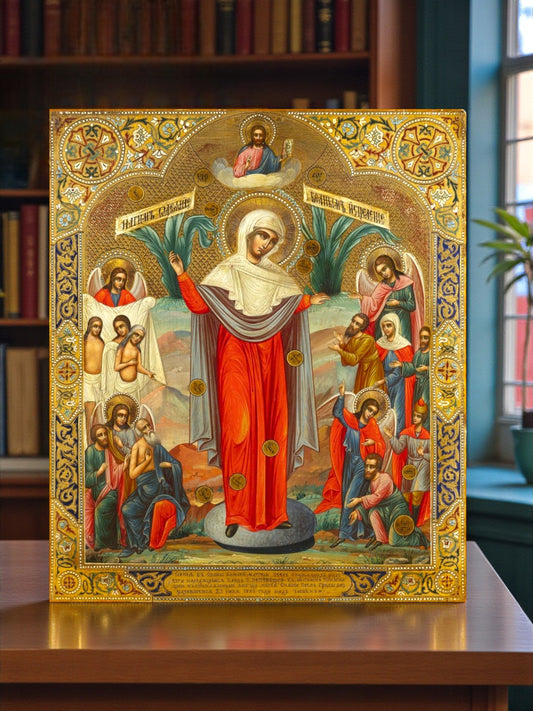
Saint Eulalia of Barcelona Icon — Holy Virgin Martyr of Spain
Saint Eulalia of Barcelona, also known as Saint Eulàlia, Santa Eulalia de Barcelona, and Saint Eulalia the Virgin Martyr, is one of the most beloved early Christian saints of Spain and a patron saint of Barcelona, Catalonia.
According to Christian tradition, Eulalia was a young girl who courageously professed her faith during the persecution of Christians under the Roman Emperor Diocletian in the early fourth century.
Although only about thirteen or fourteen years old, she refused to renounce Christ and endured martyrdom rather than offer sacrifices to the Roman gods.
Her story has been treasured for centuries as an example of courage, purity of heart, unwavering faith and spiritual strength.
Today, Saint Eulalia is honored in the Catholic and Orthodox Christian traditions and remains closely connected with the religious and cultural heritage of Barcelona.
The Life of Saint Eulalia of Barcelona
Saint Eulalia is traditionally believed to have been born near Barcino, the Roman settlement that later became Barcelona, in a Christian family.
From childhood, she was devoted to prayer, Scripture and a life of Christian virtue.
During the persecution associated with Emperor Diocletian, the Roman governor Dacian arrived in Barcelona to enforce measures against Christians.
According to her traditional Life, Eulalia secretly left her home and appeared before the governor, openly challenging the persecution and declaring her faith in Jesus Christ.
Despite her youth, she refused to offer sacrifices to the pagan gods.
The governor ordered her to be punished, but Eulalia remained steadfast in her confession of Christianity.
She was eventually put to death, becoming one of the most celebrated virgin martyrs of early Christian Spain.
Her martyrdom is traditionally dated to around AD 304.
The Martyrdom of Saint Eulalia
The traditional accounts of Saint Eulalia describe a series of severe sufferings inflicted upon her because she refused to abandon her Christian faith.
She was beaten, wounded with iron instruments and subjected to burning flames.
Throughout her suffering, the young martyr continued to pray and place her trust in God.
One of the most memorable episodes in her hagiography describes how the flames turned against her persecutors.
Another tradition tells that, at the moment of her death, a white dove emerged from her mouth and flew toward heaven.
The dove represents the departure of her soul in peace and the purity of her Christian witness.
These events belong to the traditional hagiographical accounts of Saint Eulalia and have inspired Christian sacred art for many centuries.
The Meaning of Saint Eulalia's Martyrdom
Saint Eulalia's story is remarkable because of the contrast between her young age and her extraordinary determination.
Her example teaches that spiritual courage does not depend on age, social position or earthly power.
Although she possessed no political authority, she remained faithful to her Christian convictions even when confronted with persecution.
In Christian tradition, martyrdom means bearing witness to Christ, even at the cost of one's life.
Saint Eulalia is therefore remembered not for seeking suffering, but for refusing to abandon her faith.
Her life is a reminder of the importance of conscience, courage, faithfulness, prayer and trust in God's mercy.
Saint Eulalia and the City of Barcelona
Saint Eulalia is one of the historic patron saints of Barcelona, and her memory remains deeply woven into the city's Christian heritage.
The city's great Gothic cathedral bears the dedication:
Cathedral of the Holy Cross and Saint Eulalia — Catedral de la Santa Creu i Santa Eulàlia.
The cathedral's crypt houses the tomb traditionally associated with the young martyr.
A distinctive local tradition is the presence of thirteen white geese in the cathedral cloister, representing her traditional age at martyrdom.
Every February, Barcelona celebrates the Festes de Santa Eulàlia, a festival honoring the saint through religious observances and local cultural traditions.
Her story is preserved in churches, sculptures, paintings and the historic streets of Barcelona.
For Christians with a connection to Catalonia, Saint Eulalia represents both the early history of the Church and the spiritual heritage of the city.
Saint Eulalia in Orthodox and Catholic Christianity
Saint Eulalia lived during the early centuries of Christianity, long before the formal separation of the Eastern and Western Churches.
She belongs to the heritage of early Western Christian saints and is commemorated in Orthodox and Catholic traditions.
Feast days:
She is also remembered within Orthodox commemorations of the saints of Spain and Portugal.
Saint Eulalia is especially meaningful to Christians devoted to the ancient saints of the Iberian Peninsula, the history of early Christian martyrdom and the shared Christian heritage of East and West.
Saint Eulalia of Barcelona and Saint Eulalia of Mérida
Saint Eulalia of Barcelona should be distinguished from Saint Eulalia of Mérida, another early Christian virgin martyr associated with Roman Spain.
Both saints are traditionally connected with the persecution under Diocletian, and their accounts share several similarities.
Their cults developed in different cities, however, and they have different traditional feast days.
Saint Eulalia of Barcelona is particularly associated with Barcelona and February 12, while Saint Eulalia of Mérida is commemorated on December 10 in the Western tradition.
Historical scholars have debated the relationship between their traditions, but they remain distinguished in Christian liturgical and devotional practice.
Why Choose an Icon of Saint Eulalia?
An icon of Saint Eulalia invites reflection on courage, purity of heart and loyalty to Christ.
Her life is a meaningful example for Christians seeking inspiration in times of uncertainty, opposition or difficult moral choices.
She is particularly remembered for:
-
Her unwavering Christian faith despite persecution
-
Her courage and spiritual maturity at a young age
-
Her witness as an early Christian virgin martyr
-
Her connection with the ancient Church of Spain
-
Her enduring role as a patron saint of Barcelona
An icon of Saint Eulalia is especially meaningful for a home prayer corner, a collection of Western Orthodox saints or as a religious gift for someone with the name Eulalia, Eulàlia or Eulália.
It is also a thoughtful gift for those with family roots in Barcelona, Catalonia or Spain.
Frequently Asked Questions
Who was Saint Eulalia of Barcelona?
Saint Eulalia was a young Christian virgin martyr who, according to tradition, died during the persecution under Emperor Diocletian around AD 304. She is one of Barcelona's patron saints.
How old was Saint Eulalia when she died?
Traditional accounts describe her as approximately thirteen or fourteen years old. The Barcelona cathedral's thirteen white geese represent the local tradition that she was thirteen.
What is Saint Eulalia the patron saint of?
She is a historic patron saint of Barcelona, Spain, and an important figure in the Christian heritage of Catalonia.
What does the white dove in Saint Eulalia's story symbolize?
According to her traditional Life, a white dove appeared at her death. It symbolizes her soul ascending to heaven and the purity of her Christian witness.
Where are Saint Eulalia's relics kept?
Her relics are traditionally venerated in the crypt of the Cathedral of the Holy Cross and Saint Eulalia in Barcelona.
Is Saint Eulalia an Orthodox saint?
Yes. Saint Eulalia of Barcelona is commemorated in Orthodox calendars among the early Western Christian saints and martyrs.
When is Saint Eulalia's feast day?
She is commemorated on September 4 in Orthodox calendars and February 12 in the Catholic tradition of Barcelona.
Is Saint Eulalia of Barcelona the same as Saint Eulalia of Mérida?
They have traditionally been commemorated as distinct saints associated with different cities, although historians have debated the relationship between their similar martyrdom accounts.
🖼 Product Features
Our Wooden Icon — Family Workshop in Portugal
Each icon is individually produced in our family workshop in Leiria, Portugal.
We reproduce the sacred image directly onto a carefully prepared wooden panel using detailed pigment printing, without paper or canvas.
The icon is finished by hand with natural beeswax, creating a smooth, gently matte surface.
The sides and back are hand-finished, and a hanging attachment is included.
Our icons are wooden reproductions of Christian sacred artwork rather than entirely hand-painted icons.
Gold-colored elements, where present, are reproduced using pigment colors and are not genuine gold leaf.
This icon of Saint Eulalia of Barcelona is a meaningful addition to a Christian home, a prayer corner or a collection of rare early Western saints.
- Crafted on a premium wood panel — 1.6 cm (0.6") thick, sturdy yet lightweight
- Fade-resistant pigment print — rich, true-to-life colors that last for generations
- Natural beeswax finish — hand-applied for depth, protection, and a traditional feel
- Ready to hang — metal hook pre-attached on the reverse
- Hand-finished by Orthodox Christian artisans in Portugal
📏 Available Sizes
• Small – 12 x 15 cm (5” x 6”)
• Medium – 23 x 30 cm (9” x 12”)
• Large – 30 x 39 cm (12” x 15”)
🎁 Perfect For
• Meaningful Orthodox Christian gifts
• Housewarming and family blessings
• Prayer corners and devotional spaces
• Baptisms, name days, weddings, and feast days
🌍 Worldwide Delivery
Securely packed and shipped worldwide from Portugal with tracking.
✨ Crafted with Tradition
Each icon is carefully made by Orthodox Christian artisans in Portugal — created to become a lasting blessing for your home or a treasured gift for someone you love.