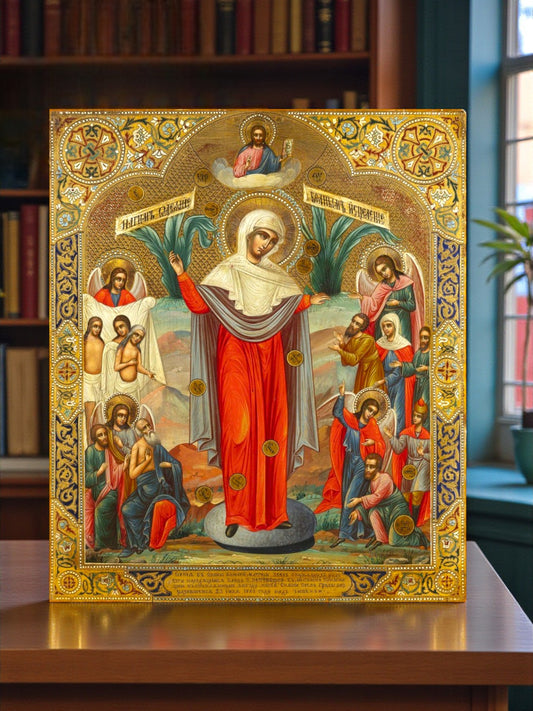
Saint Brigid of Kildare — Irish Orthodox Icon
Saint Brigid of Kildare, also known as Saint Brigid of Ireland, was one of the greatest saints of the early Irish Church, a monastic foundress and abbess whose veneration spread throughout medieval Europe.
Together with Saint Patrick and Saint Columba of Iona, she became one of the principal patron saints of Ireland.
Born in Ireland in the 5th century, Brigid dedicated herself to Christ from an early age. She became renowned for her monastic life, extraordinary generosity toward the poor, hospitality, prayer and the many miracles associated with her in Christian tradition.
She founded the famous monastery at Kildare, whose name derives from the Irish Cill Dara — “Church of the Oak.”
Saint Brigid lived centuries before the Great Schism and belongs to the ancient Christian heritage shared by East and West. She is venerated today among the Western Orthodox saints, and her feast is celebrated on February 1.
Who Was Saint Brigid of Kildare?
Saint Brigid was born in Ireland in the 5th century, traditionally around the middle of the century.
The surviving accounts of her life contain different traditions concerning her family and childhood. Some describe noble connections, while another influential tradition presents her as the daughter of an enslaved Christian woman.
This uncertainty is not surprising. The earliest surviving written Lives of Brigid were composed generations after her death, and historical details became intertwined with a rich body of Irish Christian tradition.
What emerges consistently from these accounts is the image of a woman devoted to Christ, known for prayer, asceticism, compassion and remarkable generosity to the poor.
Saint Brigid Chooses the Monastic Life
According to Christian tradition, Brigid demonstrated an unusual dedication to God from childhood.
When marriage was proposed to her, she chose instead a life consecrated to Jesus Christ.
Tradition associates her monastic profession with Saint Mel of Ardagh, one of the early bishops of the Irish Church.
Brigid eventually gathered other women around her, forming a monastic community that would become one of the most important religious centers of early Christian Ireland.
Saint Brigid and Kildare
Brigid's name became inseparably connected with Kildare.
According to tradition, she established her community near a great oak tree.
The Irish name Cill Dara means “Church of the Oak”, from which the modern name Kildare developed.
The community grew into an important center of monastic life, prayer, hospitality and Christian learning.
Brigid served as its abbess, exercising remarkable spiritual influence within the early Irish Church.
The monastery at Kildare eventually became associated with both a community of women and ecclesiastical leadership, and tradition connects Saint Conleth (Conláed) with Kildare as its bishop.
Saint Brigid and Saint Patrick
Later Irish Christian tradition closely associates Saint Brigid with Saint Patrick, the Apostle of Ireland.
Stories describe encounters between the two saints and present them as two of the foundational figures of Irish Christianity.
Some traditions even state that Brigid's parents had been baptized by Patrick and that Patrick visited Brigid near the end of his life.
Because the surviving Lives were written considerably later, individual details of these accounts should be treated as tradition rather than securely documented biography.
Nevertheless, the association of Patrick and Brigid became deeply rooted in Irish Christian memory.
Together with Saint Columba, they came to represent the three great patron saints of Ireland.
Charity and Hospitality
One of the strongest themes running through the traditions about Saint Brigid is her extraordinary generosity.
Again and again, her Lives describe her giving food, clothing and possessions to those in need.
Her charity could appear almost excessive to those around her: anything she possessed could become a gift if another person needed it more.
For this reason Saint Brigid became particularly associated with hospitality, care for the poor and Christian generosity.
These stories express an essential theme of her spiritual life — seeing Christ in those who came seeking help.
Miracles of Saint Brigid
Numerous miracles are attributed to Saint Brigid in the Irish hagiographical tradition.
She is described as healing the sick, helping the poor, providing food for those in need and bringing reconciliation where there was conflict.
Other traditions tell of her defeating demonic powers through the sign of the Cross.
Whether describing healing, hospitality or protection, these accounts consistently present Brigid's miracles as expressions of compassion and faith in Christ rather than displays of personal power.
Saint Brigid's Cross
In this icon Saint Brigid holds a distinctive woven cross, today universally associated with her.
The traditional Saint Brigid's Cross is normally woven from rushes or similar plant material and has become one of the most recognizable symbols of Irish Christianity.
A famous tradition tells how Brigid fashioned a cross while explaining the Christian faith to a dying man.
The woven cross subsequently became associated with her feast on February 1, and making Brigid's crosses remains a living Irish custom.
In the icon, therefore, the cross immediately identifies the saint while emphasizing her devotion to Christ and His Cross.
The Scroll in Saint Brigid's Hand
In her other hand Saint Brigid holds an open scroll bearing the words:
“Since first I fixed my mind on God, I have never taken it off.”
The saying expresses the central theme of Brigid's monastic vocation: once she had dedicated herself to God, her life remained directed toward Him.
In the icon the scroll complements the woven cross.
The cross represents her faith in Christ, while the scroll expresses the interior dedication of her mind and heart to God.
Together they present Brigid not merely as a historical Irish figure but as an abbess, monastic and spiritual teacher.
Why Is an Oak Tree Shown in the Icon?
The landscape surrounding Saint Brigid is not merely decorative.
The oak tree has a special connection with Kildare.
The Irish Cill Dara traditionally means “Church of the Oak,” recalling the place where Brigid established her famous monastic community.
Including an oak in her icon therefore creates a visual connection between the saint and Kildare, the center of her monastic life.
The trees, flowers and natural landscape also recall the strong association of Brigid's hagiographical tradition with creation, hospitality and the rural world of early Ireland.
Is Saint Brigid of Kildare an Orthodox Saint?
Yes. Saint Brigid of Kildare is venerated as a saint in Orthodox Christianity.
She lived in the 5th and early 6th centuries, approximately five centuries before the Great Schism of 1054.
She therefore belongs to the ancient Christian Church of the first millennium and to the remarkable tradition of saints produced by early Christian Ireland.
For Orthodox Christians today, Saint Brigid is one of the most important examples of the Western Orthodox saints — saints who lived in Western Europe while Christianity remained united.
Her feast is celebrated on February 1.
Saint Brigid — Abbess of Kildare
An important feature of Brigid's identity is that she was not simply a monastic saint but an abbess and foundress.
Her community at Kildare became extraordinarily influential, and her memory inspired later religious communities throughout Ireland.
Her icon can therefore have particular significance for women living the monastic life and for those seeking examples of Christian spiritual leadership, service and generosity.
In Orthodox terminology she may appropriately be described as Venerable Brigid, Abbess of Kildare.
Saint Brigid and the Saints of Ancient Ireland
Early Christian Ireland produced an extraordinary monastic culture.
Saints, monks and missionaries founded monasteries and carried Christianity and monastic learning far beyond Ireland itself.
Saint Brigid belongs to this tradition alongside figures such as Saint Patrick, Saint Columba of Iona, Saint Kevin of Glendalough and Saint Brendan the Navigator.
Their lives demonstrate that the history of ancient Orthodox Christianity was not limited to Byzantium and the Christian East.
A flourishing Christian and monastic tradition also existed at the westernmost edge of Europe.
For this reason Saint Brigid has an important place in our collection of Western Orthodox Saints.
The Relics of Saint Brigid and Portugal
Saint Brigid has a particularly remarkable historical connection with Portugal.
Medieval tradition holds that relics of Brigid were associated with those of Saint Patrick and Saint Columba at Downpatrick. Their later history became complicated, and accounts of the translation and survival of Brigid's relics vary.
However, an important tradition concerning her relics survives in Lisbon.
A relic venerated as part of Saint Brigid's skull has for centuries been preserved at the Church of Saint John the Baptist in Lumiar (Igreja de São João Baptista do Lumiar).
An old Portuguese inscription at the church records the tradition that three Irish knights brought the relic of Saint Brigid to Portugal in the 13th century. Portuguese heritage records likewise connect the relic with the reign of King Dinis.
Another portion of a skull attributed to Saint Brigid is preserved at the Church of São Roque in Lisbon, where it entered the Jesuit collection of relics in 1587.
The Portuguese connection continues today. A fragment originating from the Lumiar relic and preserved by the Brigidine Sisters was ceremonially returned to Kildare in January 2024.
For an icon individually produced in our workshop in Portugal, this centuries-old connection between Saint Brigid, Ireland and Portugal gives the image a particularly meaningful historical context.
Saint Brigid — Patron Saint of Ireland
Saint Brigid became one of the principal patron saints of Ireland, together with Saint Patrick and Saint Columba.
Her veneration spread well beyond Ireland during the Middle Ages, with churches and communities dedicated to her throughout Europe.
She remains one of the most recognizable female saints of the Irish Christian tradition.
Her feast on February 1 also marks the traditional beginning of spring in Ireland and remains closely associated with the making of Saint Brigid's crosses.
A Saint Brigid Icon for Prayer
An icon of Saint Brigid of Kildare can be especially meaningful for Christians of Irish heritage, those devoted to the ancient saints of Ireland, monastics, and people seeking an example of generosity and dedication to God.
It can also make a meaningful patron saint or name-day gift for someone named Brigid, Bridget, Brigitte, Brígida, Brigida or Brigitte.
Our reproduction is carefully produced on a prepared wooden panel and individually hand-finished with natural beeswax in our family workshop in Portugal.
Feast Day: February 1.
Frequently Asked Questions
Who was Saint Brigid of Kildare?
Saint Brigid was a 5th–6th-century Irish Christian nun, abbess and monastic foundress associated with Kildare. She became one of the principal patron saints of Ireland.
Is Saint Brigid of Kildare an Orthodox saint?
Yes. Saint Brigid lived centuries before the Great Schism and is venerated among the saints of the ancient undivided Church.
Why does Saint Brigid hold a woven cross?
The woven Saint Brigid's Cross is one of her best-known attributes. Irish tradition associates Brigid with making a cross from rushes while explaining the Christian faith.
What does the scroll in the Saint Brigid icon say?
The scroll reads: “Since first I fixed my mind on God, I have never taken it off.” It expresses her lifelong dedication to God.
Why is Saint Brigid associated with an oak tree?
Her monastery was founded at Kildare. The Irish name Cill Dara means “Church of the Oak,” traditionally connecting the monastery with a great oak tree.
Where are Saint Brigid's relics?
Several traditions exist concerning her relics. Particularly notable are relics attributed to Saint Brigid preserved in Lisbon, Portugal, including a skull relic at São João Baptista do Lumiar and another portion at São Roque.
When is Saint Brigid's feast day?
Saint Brigid is commemorated on February 1, including in traditions honoring the ancient Celtic and British saints.
🖼 Product Features
Each icon in our workshop is made to last a lifetime and beyond. The image is printed with rich, fade-resistant pigment inks on a premium solid-core wood panel — then hand-finished with a natural beeswax coating that deepens the colors, protects the surface, and gives each piece the warm, reverent quality of a traditionally crafted sacred object. A metal hanging hook is included on the back, so your icon is ready to display the moment it arrives.
- Crafted on a premium wood panel — 1.6 cm (0.6") thick, sturdy yet lightweight
- Fade-resistant pigment print — rich, true-to-life colors that last for generations
- Natural beeswax finish — hand-applied for depth, protection, and a traditional feel
- Ready to hang — metal hook pre-attached on the reverse
- Hand-finished by Orthodox Christian artisans in Portugal
📏 Available Sizes
• Small – 12 x 15 cm (5” x 6”)
• Medium – 23 x 30 cm (9” x 12”)
• Large – 30 x 39 cm (12” x 15”)
🎁 Perfect For
• Meaningful Orthodox Christian gifts
• Housewarming and family blessings
• Prayer corners and devotional spaces
• Baptisms, name days, weddings, and feast days
🌍 Worldwide Delivery
Securely packed and shipped worldwide from Portugal with tracking.
✨ Crafted with Tradition
Each icon is carefully made by Orthodox Christian artisans in Portugal — created to become a lasting blessing for your home or a treasured gift for someone you love.