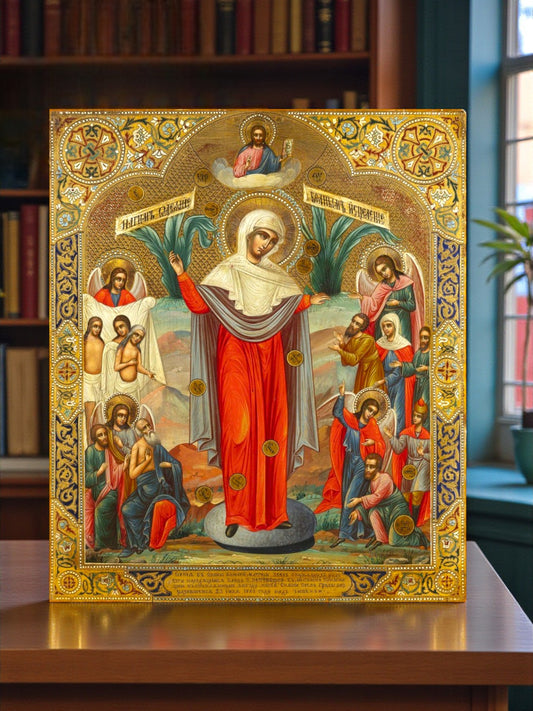
Saint Benedict of Nursia — Orthodox Icon
Saint Benedict of Nursia, also known as Saint Benedict of Norcia, was one of the most influential monastic saints of the ancient Christian West. Born in Italy around AD 480, he became a hermit, spiritual father and founder of monastic communities whose influence would shape Christian monasticism in Western Europe for centuries.
Saint Benedict lived long before the Great Schism of 1054 and belongs to the shared spiritual heritage of the ancient undivided Church. He is venerated in the Eastern Orthodox Church as Venerable Benedict of Nursia, making his icon especially significant among the icons of Western Orthodox saints.
Who Was Saint Benedict of Nursia?
Saint Benedict was born around 480 in Nursia, the ancient Italian town now known as Norcia.
As a young man he was sent to Rome for his education. Disturbed by the worldly life he encountered there, Benedict left the city and chose a life dedicated to God.
Eventually he withdrew to Subiaco, where he lived for approximately three years in a cave under the spiritual guidance of the monk Romanus.
His life of prayer and asceticism gradually became known, and disciples began gathering around him seeking spiritual guidance.
Saint Benedict at Subiaco
As the number of his followers increased, Benedict organized them into monastic communities.
His vision of monastic life was not simply one of isolation. It emphasized life in community under spiritual authority, combining prayer, obedience, humility, discipline and work.
This balanced understanding of communal monastic life would eventually find its fullest expression in the famous Rule of Saint Benedict.
Saint Benedict and Monte Cassino
Benedict eventually left Subiaco and settled at Monte Cassino, between Rome and Naples.
There he founded the monastery that became inseparably associated with his name.
Monte Cassino would grow into one of the most important monasteries in the history of Western Christianity and a major center of monastic culture and learning.
It was there that Saint Benedict established the monastic tradition for which he became famous and composed the Rule associated with his name.
The Rule of Saint Benedict
The Rule of Saint Benedict became one of the most influential texts in the history of Christian monasticism.
Rather than demanding extraordinary ascetic practices from every monk, the Rule establishes an ordered communal life shaped by prayer, obedience, humility, spiritual discipline and work.
The abbot serves as spiritual father of the community, while the monks live together according to a common rhythm of worship and daily responsibilities.
The Rule would eventually become the principal foundation of Western monastic life for centuries. Orthodox sources also note its relationship to the earlier monastic traditions of the Christian East, including the influence of Saint John Cassian and the monastic tradition associated with Saint Basil the Great.
“Ora et Labora” — Prayer and Work
Saint Benedict is frequently associated with the Latin expression “Ora et Labora” — “Pray and Work.”
Although this concise phrase is a later summary rather than a direct motto written by Benedict himself, it expresses an important principle associated with Benedictine spirituality: everyday work and prayer should not exist as separate worlds.
The monastic day becomes a unified offering to God through worship, spiritual reading, obedience and necessary work.
For this reason, Saint Benedict became a powerful Christian symbol of ordered spiritual life, perseverance and the sanctification of daily work.
Saint Benedict and Eastern Monastic Tradition
Although Saint Benedict became enormously influential in Western Europe, his spirituality did not arise in isolation from the Christian East.
Western monasticism had already been deeply influenced by the traditions of the Egyptian Desert Fathers and by figures such as Saint John Cassian, who transmitted Eastern monastic experience to the Latin-speaking Christian world.
Orthodox historical accounts of Benedict specifically recognize these connections, making him an important example of the spiritual exchange that existed between Eastern and Western Christianity during the first millennium.
Saint Benedict and Saint Scholastica
Saint Benedict's sister, Saint Scholastica, also dedicated her life to God and became one of the best-known female monastic saints of the ancient West.
The lives of Benedict and Scholastica are closely associated in Christian tradition, particularly through the account preserved by Saint Gregory the Great (Gregory the Dialogist).
Gregory's Dialogues are the principal early literary source for the life of Saint Benedict.
This creates a particularly beautiful connection between two saints in our Western Orthodox Saints collection: Saint Benedict of Nursia and Saint Gregory the Great, the Pope of Rome who preserved Benedict's life for later generations.
Is Saint Benedict an Orthodox Saint?
Yes. Saint Benedict of Nursia is venerated in the Orthodox Church.
He lived in the 5th and 6th centuries, approximately five hundred years before the Great Schism between Rome and Constantinople.
In Orthodox tradition he is commemorated as Venerable Benedict of Nursia, and his feast is celebrated on March 14. The Orthodox Church remembers his ascetic life, spiritual wisdom and importance in the development of Western Christian monasticism.
For this reason, Saint Benedict should not be understood exclusively as a later Roman Catholic saint. He belongs historically to the ancient Christian Church and represents the rich Orthodox heritage of the Christian West before the Schism.
Saint Benedict — A Western Orthodox Saint
The life of Saint Benedict demonstrates how deeply monastic Christianity had taken root in Western Europe during the centuries of the undivided Church.
Italy, Gaul, Ireland, Britain and the Iberian Peninsula produced generations of bishops, missionaries, monks, hermits and martyrs who lived before the division between Eastern and Western Christianity.
Saint Benedict stands among the greatest of these Western Orthodox saints.
His legacy also connects the ancient monastic traditions of the Christian East with the development of Western European monasticism.
Saint Benedict in Orthodox Iconography
Orthodox icons generally portray Saint Benedict as a venerable monastic elder, emphasizing his ascetic life and his role as a spiritual father.
Depending on the particular iconographic composition, he may be depicted in monastic garments and may hold a scroll, representing his spiritual teaching and monastic Rule.
Unlike later Western representations that may use specifically Benedictine symbols, Orthodox iconography presents him primarily within the traditional visual language used for venerable monastic saints.
Saint Benedict Medal and the Orthodox Icon
Many people searching for Saint Benedict are familiar with the famous Saint Benedict Medal.
The medal belongs to a later Western devotional tradition and should be distinguished from the traditional Orthodox icon of the saint.
An Orthodox icon does not function as a magical object or talisman. It presents the saint as a member of the Church glorified in Christ and assists the faithful in prayer and remembrance.
For Orthodox Christians, Saint Benedict is honored for his holiness, ascetic struggle and spiritual teaching rather than through superstition surrounding particular objects.
What Is Saint Benedict the Patron Saint Of?
In Western Christian tradition, Saint Benedict became particularly associated with monks and monastic life and is widely regarded as a patron of monastics.
His life and Rule also make his icon a meaningful Christian gift for anyone seeking greater discipline, stability and prayer in everyday life.
For a person named Benedict, Benito, Benedetto, Benoît or Bento, an icon of Saint Benedict can also serve as a meaningful patron saint or name-day gift.
A Saint Benedict Icon for Prayer
The icon of Saint Benedict of Nursia recalls one of the central teachings of Christian monasticism: holiness is cultivated through a faithful life of prayer, humility, obedience and perseverance.
His example is meaningful not only for monks but for Christians seeking to establish greater spiritual order and attention to God within ordinary daily life.
Our reproduction is carefully produced on a prepared wooden panel and individually hand-finished with natural beeswax in our family workshop in Portugal.
Orthodox Feast Day: March 14.
Frequently Asked Questions
Is Saint Benedict of Nursia an Orthodox saint?
Yes. Saint Benedict lived centuries before the Great Schism and is venerated by the Eastern Orthodox Church as Venerable Benedict of Nursia. His Orthodox feast day is March 14.
Are Saint Benedict of Nursia and Saint Benedict of Norcia the same person?
Yes. Nursia is the Latin form of the name of the Italian town now called Norcia. Saint Benedict of Nursia, Benedict of Norcia and St Benedict all refer to the same saint.
What is Saint Benedict famous for?
He is especially known for establishing the monastery at Monte Cassino and for the Rule of Saint Benedict, which profoundly influenced Western Christian monasticism.
Who wrote the earliest important account of Saint Benedict's life?
The principal early source is Book II of the Dialogues of Saint Gregory the Great, also known as Gregory the Dialogist.
What does Saint Benedict hold in an Orthodox icon?
Depending on the icon, Saint Benedict may hold a scroll representing his monastic teaching and spiritual wisdom.
When is Saint Benedict celebrated in the Orthodox Church?
The Orthodox Church commemorates Venerable Benedict of Nursia on March 14.
🖼 Product Features
Each icon in our workshop is made to last a lifetime and beyond. The image is printed with rich, fade-resistant pigment inks on a premium solid-core wood panel — then hand-finished with a natural beeswax coating that deepens the colors, protects the surface, and gives each piece the warm, reverent quality of a traditionally crafted sacred object. A metal hanging hook is included on the back, so your icon is ready to display the moment it arrives.
- Crafted on a premium wood panel — 1.6 cm (0.6") thick, sturdy yet lightweight
- Fade-resistant pigment print — rich, true-to-life colors that last for generations
- Natural beeswax finish — hand-applied for depth, protection, and a traditional feel
- Ready to hang — metal hook pre-attached on the reverse
- Hand-finished by Orthodox Christian artisans in Portugal
📏 Available Sizes
• Small – 12 x 15 cm (5” x 6”)
• Medium – 23 x 30 cm (9” x 12”)
• Large – 30 x 39 cm (12” x 15”)
🎁 Perfect For
• Meaningful Orthodox Christian gifts
• Housewarming and family blessings
• Prayer corners and devotional spaces
• Baptisms, name days, weddings, and feast days
🌍 Worldwide Delivery
Securely packed and shipped worldwide from Portugal with tracking.
✨ Crafted with Tradition
Each icon is carefully made by Orthodox Christian artisans in Portugal — created to become a lasting blessing for your home or a treasured gift for someone you love.