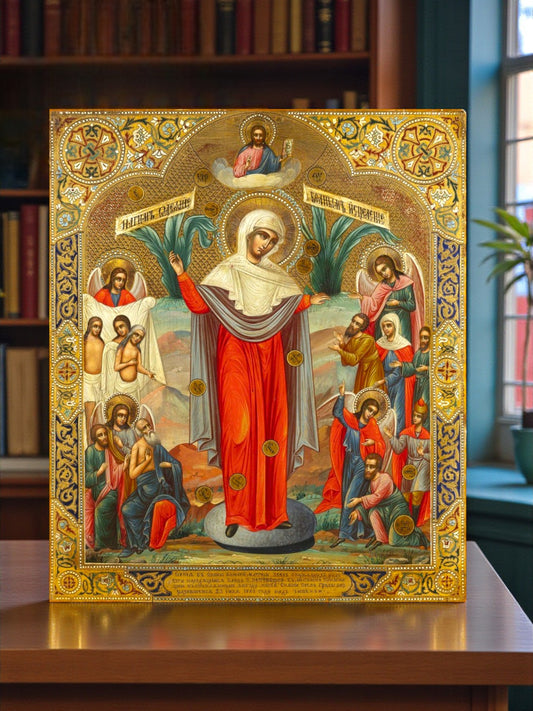
Saint Augustine of Hippo — Orthodox Icon
Saint Augustine of Hippo, also known in Orthodox tradition as Blessed Augustine, Bishop of Hippo, was one of the most influential Christian theologians, bishops and spiritual writers of the ancient Western Church.
Born in Roman North Africa in AD 354, Augustine passed through a long spiritual search before embracing Christianity under the influence of the Scriptures, the prayers of his mother Saint Monica, and the preaching of Saint Ambrose of Milan.
He was baptized in Milan in 387 and later became Bishop of Hippo in North Africa, serving the Church until his repose in 430.
His works — particularly the Confessions and The City of God — became classics of Christian literature.
Saint Augustine lived more than six centuries before the Great Schism and is commemorated in the Orthodox Church, making him one of the most prominent Western Orthodox saints of the ancient undivided Church.
Who Was Saint Augustine of Hippo?
Augustine was born on November 13, 354, in Thagaste, a town in Roman North Africa located in present-day Algeria.
His mother, Saint Monica, was a devout Christian whose persistent prayers for her son's conversion became one of the best-known stories of early Christianity.
As a young man, however, Augustine did not immediately embrace his mother's faith.
Highly intelligent and ambitious, he received an extensive education and became a teacher of rhetoric. His intellectual and professional journey eventually took him from Carthage to Rome and then to Milan.
At the same time, Augustine was searching for answers to profound questions about God, truth, good and evil, and the meaning of human existence.
The Conversion of Saint Augustine
In Milan Augustine encountered Saint Ambrose, the city's celebrated bishop.
Ambrose's preaching helped Augustine understand Christianity in a new way and encouraged him to study the Holy Scriptures more deeply.
Augustine's conversion was not merely an intellectual change. It represented a profound transformation of his entire life.
He received Holy Baptism in Milan in 387 from Saint Ambrose.
After returning to North Africa, Augustine pursued a life centered on prayer and Christian community.
His journey from spiritual uncertainty to Christian faith later became the subject of his most famous autobiographical work, the Confessions.
Saint Augustine and Saint Monica
The story of Augustine cannot easily be separated from that of his mother, Saint Monica.
For years Monica prayed for her son's conversion while following his spiritual journey with extraordinary patience and hope.
She lived to see Augustine embrace Christianity and receive Baptism.
Their relationship, described movingly in the Confessions, became one of the most celebrated examples of a mother's persistent Christian prayer for her child.
For this reason, icons of Saint Augustine and Saint Monica have particular meaning for Christian families, parents and those praying for loved ones.
Bishop of Hippo
In 391, Augustine was ordained a priest by Bishop Valerius of Hippo.
In 395 he became a bishop and subsequently succeeded Valerius as Bishop of Hippo, a position he would hold for approximately 35 years.
As bishop, Augustine preached, taught, wrote extensively and participated in some of the most important theological controversies of his age.
He defended the Church against movements including Manichaeism, Donatism and Pelagianism and produced an enormous body of theological, pastoral and biblical writing.
The Confessions of Saint Augustine
The Confessions is Augustine's most famous work and one of the great classics of Christian literature.
Rather than being simply a modern autobiography, the book is fundamentally addressed to God.
Augustine reflects upon his childhood, ambitions, sins, intellectual searching and eventual conversion while examining memory, desire, time, grace and the human longing for God.
The work has remained influential for more than sixteen centuries because Augustine writes with unusual honesty about the interior struggle of a person seeking truth.
One of its central themes is that the human heart cannot find its ultimate fulfillment apart from God.
The City of God
Another monumental work is The City of God (De Civitate Dei).
Augustine began writing it after the sack of Rome by the Visigoths in 410, at a time when many people were questioning Christianity and the future of Roman civilization.
The work contrasts the transient kingdoms and ambitions of this world with the eternal City of God.
Rather than identifying Christianity with any particular earthly empire, Augustine presents Christian history within the larger perspective of God's providence and humanity's ultimate destiny.
Together, the Confessions and City of God made Augustine one of the most influential Christian writers of late antiquity.
Is Saint Augustine an Orthodox Saint?
Yes. Augustine of Hippo is commemorated as a saint in the Orthodox Church.
This point sometimes causes confusion because Orthodox theologians have debated aspects of Augustine's theological legacy, particularly interpretations that developed around some of his writings in later Western Christianity.
However, disagreement with particular theological formulations does not mean that the Orthodox Church simply rejects Augustine as a saint.
The Orthodox Church in America explicitly identifies him as Blessed Augustine, Bishop of Hippo, notes his commemoration in Orthodox calendars, and gives his Orthodox feast as June 15.
Augustine therefore belongs to the ancient Western Christian tradition that existed centuries before the separation of Eastern and Western Christianity.
Saint Augustine and Orthodox Christianity
Augustine's reception in the Christian East developed differently from his enormous influence in Latin Christianity.
His writings were not as widely available in Greek during the early centuries, and consequently his theological influence in the Byzantine East was much smaller than in Western Europe.
This historical difference helps explain why Orthodox Christians may approach some aspects of Augustine's theology differently while nevertheless honoring Blessed Augustine as a holy Bishop of the ancient Church.
For an Orthodox icon page this distinction is important: Augustine should neither be presented as somehow “not really Orthodox” nor should later differences between Eastern and Western theology simply be ignored.
He belongs to the shared Christian world of the first millennium.
Saint Augustine and the Western Orthodox Saints
Saint Augustine lived during a period when the Mediterranean Christian world remained united through a common sacramental and ecclesiastical life despite important regional theological traditions.
He was a contemporary of many saints honored throughout Christianity.
His life is especially connected with Saint Monica and Saint Ambrose of Milan, while his writings became part of the broader intellectual heritage inherited by later Western saints.
For this reason Augustine is an essential figure in any collection devoted to Western Orthodox Saints.
Together with saints such as Benedict of Nursia, Gregory the Great, Martin of Tours, Ambrose of Milan and Leo the Great, he represents the ancient Christian heritage of the West before the Great Schism.
Saint Augustine in Orthodox Iconography
In Orthodox iconography Augustine is normally represented as a holy bishop and hierarch.
He may wear episcopal vestments and hold a Gospel book or scroll, emphasizing his role as a bishop, teacher and Christian writer.
Orthodox icons generally identify him as Blessed Augustine, Bishop of Hippo or Saint Augustine of Hippo rather than emphasizing the later artistic attributes found in Western religious painting.
His icon therefore places one of the most famous Latin Christian theologians within the visual tradition of the saints and hierarchs of the ancient Church.
Saint Augustine or Blessed Augustine?
Both forms can be encountered in Orthodox English.
Saint Augustine of Hippo is the name most familiar to the general English-speaking public.
Orthodox sources also frequently use:
Blessed Augustine of Hippo
Blessed Augustine, Bishop of Hippo
Saint Augustine, Bishop of Hippo
The word “Blessed” in this context should not be confused with the modern Roman Catholic distinction between beatification and canonization.
Orthodox sources that call him “Blessed Augustine” nevertheless recognize him among the saints.
For this reason I use Saint Augustine of Hippo as the main product name while retaining Blessed Augustine throughout the description for Orthodox search queries.
A Saint Augustine Icon for Prayer
The life of Saint Augustine is particularly meaningful for those seeking God after periods of uncertainty, spiritual struggle or profound change.
His journey reminds Christians that intellectual searching and repentance can lead not away from faith but toward a deeper encounter with God.
An icon of Saint Augustine can also be a meaningful gift for someone named Augustine, Augustin, Agostino, Agustín or Augustinus, for students of theology and philosophy, and for those especially devoted to the ancient saints of the Christian West.
Our reproduction is carefully produced on a prepared wooden panel and individually hand-finished with natural beeswax in our family workshop in Portugal.
Orthodox Feast Day: June 15.
Frequently Asked Questions
Is Augustine of Hippo an Orthodox saint?
Yes. Augustine is commemorated by the Orthodox Church as Blessed Augustine, Bishop of Hippo. His Orthodox feast is June 15.
Why do Orthodox Christians call him Blessed Augustine?
“Blessed Augustine” is a traditional Orthodox designation for the saint. It does not mean that Orthodox Christianity regards him merely as Roman Catholic “Blessed” rather than a saint.
Who was Saint Augustine's mother?
His mother was Saint Monica, whose prayers and Christian example played an important role in the story of his conversion.
Who baptized Saint Augustine?
Augustine was baptized in Milan after coming under the influence of Saint Ambrose of Milan and studying the Scriptures.
What are Saint Augustine's most famous books?
His best-known works include the Confessions and The City of God, along with numerous theological, biblical and pastoral writings.
When did Saint Augustine die?
He died in Hippo on August 28, 430, while the city was under Vandal siege. The Orthodox Church commemorates him on June 15.
🖼 Product Features
Each icon in our workshop is made to last a lifetime and beyond. The image is printed with rich, fade-resistant pigment inks on a premium solid-core wood panel — then hand-finished with a natural beeswax coating that deepens the colors, protects the surface, and gives each piece the warm, reverent quality of a traditionally crafted sacred object. A metal hanging hook is included on the back, so your icon is ready to display the moment it arrives.
- Crafted on a premium wood panel — 1.6 cm (0.6") thick, sturdy yet lightweight
- Fade-resistant pigment print — rich, true-to-life colors that last for generations
- Natural beeswax finish — hand-applied for depth, protection, and a traditional feel
- Ready to hang — metal hook pre-attached on the reverse
- Hand-finished by Orthodox Christian artisans in Portugal
📏 Available Sizes
• Small – 12 x 15 cm (5” x 6”)
• Medium – 23 x 30 cm (9” x 12”)
• Large – 30 x 39 cm (12” x 15”)
🎁 Perfect For
• Meaningful Orthodox Christian gifts
• Housewarming and family blessings
• Prayer corners and devotional spaces
• Baptisms, name days, weddings, and feast days
🌍 Worldwide Delivery
Securely packed and shipped worldwide from Portugal with tracking.
✨ Crafted with Tradition
Each icon is carefully made by Orthodox Christian artisans in Portugal — created to become a lasting blessing for your home or a treasured gift for someone you love.