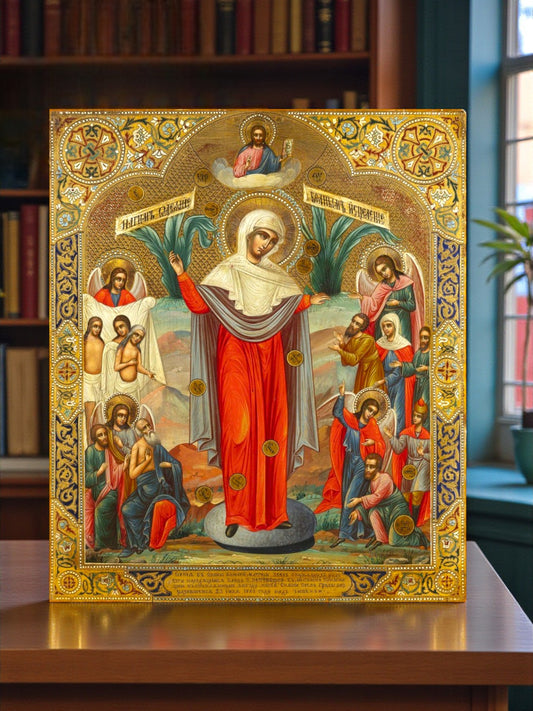
Saint Aemilian of Cogolla — San Millán Orthodox Icon
Saint Aemilian of Cogolla, known in Spain as San Millán de la Cogolla, was a 6th-century hermit, priest and one of the most celebrated early Christian saints of the Iberian Peninsula.
Also known by his Latin name Aemilianus Cucullatus, Saint Aemilian lived approximately from 473 to 574, long before the division between Eastern and Western Christianity.
This rare icon depicts the saint standing before the Monastery of San Millán de Yuso, recalling the extraordinary spiritual and cultural legacy that developed around his memory in La Rioja, Spain.
Who Was Saint Aemilian of Cogolla?
Saint Aemilian — Emiliano or Millán in the Spanish tradition — was born around 473 in the region of present-day La Rioja.
According to his early Life, Aemilian spent his youth as a shepherd. At about twenty years of age, he was drawn toward the ascetic life and became a disciple of the hermit Saint Felix (San Felices).
Aemilian subsequently withdrew into solitude in the mountains, where he devoted many years to prayer and asceticism.
His reputation for holiness eventually attracted attention, and Didymus, Bishop of Tarazona, ordained him a priest and placed him in pastoral service.
Aemilian's generosity toward the poor, however, created difficulties. He eventually returned to the solitary life that had always been his true vocation.
As his reputation grew, disciples gathered around him, forming the beginnings of the monastic tradition that would later become inseparably associated with his name.
San Millán de la Cogolla
In Spain, Saint Aemilian is much better known as San Millán.
The name Millán developed from the Latin Aemilianus, while the place that grew around his monastic legacy became known as San Millán de la Cogolla.
Saint Aemilian died in 574, traditionally at the age of 101. His memory continued to attract monks and pilgrims, and the monastic community associated with him developed over the following centuries.
Today the monasteries of Suso and Yuso at San Millán de la Cogolla are among the most important historic monastic sites in Spain.
The Monastery Behind Saint Aemilian
In this icon, Saint Aemilian stands before the Monastery of San Millán de Yuso.
The monastery visible behind him belongs to a much later period than the saint himself and therefore should not be understood as a literal representation of a building Aemilian saw during his lifetime.
Instead, it represents his spiritual legacy.
The earliest community associated with Saint Aemilian developed around the place of his hermitage and burial. The later monasteries of Suso (“upper”) and Yuso (“lower”) grew from this centuries-long tradition.
Both monasteries were inscribed as a UNESCO World Heritage Site in 1997.
What Does the Latin Inscription Mean?
The icon identifies the saint using traditional Latin inscriptions.
On the left appears:
SCS AEMILIANVS
SCS is an abbreviated form of Sanctus, meaning “Saint,” while Aemilianus is the Latin form of his name.
The inscription therefore reads:
Sanctus Aemilianus — Saint Aemilian.
On the opposite side appears:
CVCVLLATVS
This is the Latin Cucullatus, a traditional form associated with the saint's name and the later designation de la Cogolla.
Together the inscriptions identify the figure as:
Sanctus Aemilianus Cucullatus — Saint Aemilianus Cucullatus.
Saint Aemilian in Early Christian Spain
Saint Aemilian lived during a fascinating period in the history of Christianity.
The Western Roman Empire had recently disappeared, while the Visigoths controlled much of the Iberian Peninsula. Christianity, however, was already deeply established in Hispania.
Aemilian represents the ascetic Christianity of this early period: a shepherd who abandoned ordinary life for prayer, solitude and radical simplicity.
His importance is particularly well documented because his Life, the Vita Sancti Emiliani, was written by Saint Braulio, Bishop of Zaragoza, in the 7th century, drawing on traditions preserved by people close to Aemilian's disciples.
This makes his story far more than a late medieval legend: his memory reaches back remarkably close to the world in which he actually lived.
Is Saint Aemilian of Cogolla an Orthodox Saint?
Saint Aemilian lived in the undivided Christian Church, centuries before the Great Schism between Eastern and Western Christianity.
For this reason, he belongs to the ancient Christian heritage of Western Europe that predates the later separation of the Churches.
His life as an ascetic and hermit also closely resembles the monastic ideals found throughout the Christian East and West during the first millennium.
This icon is therefore especially meaningful for those interested in the early saints of Spain and the shared Christian heritage of the first millennium.
Saint Aemilian, San Millán or Aemilianus Cucullatus?
These names refer to the same saint.
Depending on the language and historical source, you may encounter:
Saint Aemilian of Cogolla
Saint Emilian of Cogolla
St Aemilian of Cogolla
San Millán de la Cogolla
San Millán
San Emiliano
Aemilianus Cucullatus
Saint Aemilianus Cucullatus
The Spanish Millán ultimately derives from the Latin name Aemilianus.
Including these different forms is particularly useful for this saint because his English, Spanish and Latin names look surprisingly different.
A Rare Icon of an Early Spanish Saint
Icons of Saint Aemilian of Cogolla are considerably less common than images of many Eastern saints.
His icon offers a connection with the ancient Christian history of the Iberian Peninsula and with a monastic tradition that has endured for more than a millennium.
It may be especially meaningful for someone named Aemilian, Emilian, Emiliano or Millán, for Christians with a connection to Spain, for a home prayer corner, or for collectors seeking icons of unusual pre-Schism Western saints.
Our reproduction is carefully produced on a prepared wooden panel and individually hand-finished with natural beeswax in our family workshop in Portugal.
Feast Day: November 12.
FAQ
Who was Saint Aemilian of Cogolla?
Saint Aemilian was a 6th-century Spanish hermit and priest who lived approximately from 473 to 574. His ascetic community became the origin of the monastic tradition of San Millán de la Cogolla.
Are Saint Aemilian and San Millán the same saint?
Yes. San Millán is the traditional Spanish name for Saint Aemilian (Aemilianus).
What does Aemilianus Cucullatus mean?
Aemilianus is the saint's Latin name. Cucullatus is the Latin form traditionally associated with his designation and with the name Cogolla.
Why is a monastery shown behind Saint Aemilian?
The monastery represents the centuries-long monastic tradition that developed around the saint. The building should not be interpreted as a literal depiction of the monastery during Aemilian's lifetime.
When is the feast of Saint Aemilian of Cogolla?
His feast is celebrated on November 12.
🖼 Product Features
Each icon in our workshop is made to last a lifetime and beyond. The image is printed with rich, fade-resistant pigment inks on a premium solid-core wood panel — then hand-finished with a natural beeswax coating that deepens the colors, protects the surface, and gives each piece the warm, reverent quality of a traditionally crafted sacred object. A metal hanging hook is included on the back, so your icon is ready to display the moment it arrives.
- Crafted on a premium wood panel — 1.6 cm (0.6") thick, sturdy yet lightweight
- Fade-resistant pigment print — rich, true-to-life colors that last for generations
- Natural beeswax finish — hand-applied for depth, protection, and a traditional feel
- Ready to hang — metal hook pre-attached on the reverse
- Hand-finished by Orthodox Christian artisans in Portugal
📏 Size: 14x30 cm (6"x12")
🎁 Perfect For
• Meaningful Orthodox Christian gifts
• Housewarming and family blessings
• Prayer corners and devotional spaces
• Baptisms, name days, weddings, and feast days
🌍 Worldwide Delivery
Securely packed and shipped worldwide from Portugal with tracking.
✨ Crafted with Tradition
Each icon is carefully made by Orthodox Christian artisans in Portugal — created to become a lasting blessing for your home or a treasured gift for someone you love.