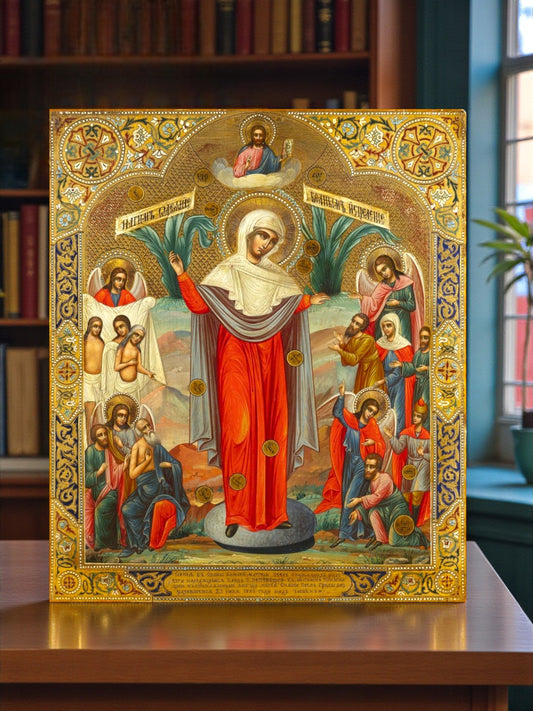
Mother of God “Lamentation at the Cross” — Rare 19th-Century Russian Orthodox Icon
The Mother of God “Lamentation at the Cross” (Plach pri Kreste Presvyatoy Bogoroditsy) is a rare and deeply moving Orthodox icon portraying the sorrow of the Virgin Mary as she contemplates the suffering and Crucifixion of her Son, Jesus Christ.
This wooden reproduction is based on a 19th-century Russian icon preserved in a private collection.
Unlike the more familiar images of the Virgin Mary holding the Christ Child, this composition depicts the Theotokos alone, surrounded by the symbols of Christ's Passion.
A sword points toward her heart, recalling the prophecy of Saint Simeon the God-Receiver:
“Yea, a sword shall pierce through thy own soul also.” — Luke 2:35 (KJV)
The icon brings together the sorrow of the Mother of God, the instruments of Christ's suffering and the promise of salvation through His sacrifice.
Iconography — The Sorrowing Mother of God
The Virgin Mary is shown with her head gently inclined and her hands crossed over her chest in an expression of profound grief and silent prayer.
She wears a deep red-brown maphorion, richly decorated with pearl-like borders and delicate ornamental details. A large golden halo surrounds her head against the warm ochre background.
Her sorrowful face is the spiritual center of the composition.
A sword extends toward her heart, recalling the prophecy spoken to Mary when the Infant Jesus was presented in the Temple.
Although she does not stand beside the crucified Christ in this image, the surrounding symbols evoke the events of His betrayal, Passion, Crucifixion and burial.
The entire composition transforms the Gospel narrative into a visual meditation on the suffering of the Mother of God.
The Instruments of Christ's Passion
One of the most distinctive features of this historical icon is the collection of objects associated with the final hours of Jesus Christ's earthly life.
The sword near Mary's heart represents Saint Simeon's prophecy and the deep spiritual pain the Mother of God would experience during her Son's suffering.
The Cross on Golgotha recalls the Crucifixion, the central event of Christ's saving sacrifice.
The ladder recalls the removal of Christ's body from the Cross and the preparation for His burial.
The column and bird belong to a traditional group of Passion symbols. In related Russian icons, a rooster upon a column refers to the threefold denial of Christ by the Apostle Peter. In this particular version, the bird is rendered in a distinctive pale form.
The hammer and other implements recall the physical suffering and Crucifixion of Christ.
The Crown of Thorns, represented among the objects along the lower border, recalls the mockery and suffering endured by the Savior.
The architectural background suggests Jerusalem and the setting of the Passion narrative.
These symbolic elements invite the viewer to contemplate not only the sorrow of the Virgin Mary but also the events through which Christ accomplished the redemption of humanity.
The Prophecy of Saint Simeon
The biblical foundation of this image is found in the Gospel of Luke.
When the Virgin Mary and Saint Joseph presented the Infant Jesus in the Temple of Jerusalem, the righteous elder Simeon recognized Him as the promised Messiah.
Simeon proclaimed that Jesus would be a light to the nations and then spoke directly to Mary, foretelling the sword that would pierce her soul.
In the Christian tradition, this prophecy is understood as referring to the suffering of the Mother of God as she witnesses her Son's rejection, Passion and death.
The sword in this icon is therefore a theological symbol of spiritual sorrow, not a representation of a physical wound.
The image also recalls the Gospel of John, where Mary stands near the Cross of Christ (John 19:25–27).
The History of “Lamentation at the Cross”
The iconographic subject known in Russian as «Плач при Кресте» developed within the tradition of images of the Sorrowing Mother of God.
It was particularly represented in Russian icon painting of the eighteenth and nineteenth centuries.
The composition is related to the broader Christian tradition of contemplating the grief of the Virgin Mary during the Passion.
Some versions share visual characteristics with the Akhtyrskaya (Akhtyrka) Mother of God, while others introduce extensive representations of the Instruments of the Passion, a sword at Mary's heart and symbolic landscapes of Golgotha.
The imagery also reveals the influence of Western Christian devotional art, especially depictions of the Sorrowful Virgin and the Instruments of Christ's Passion.
Over time, these elements were adapted into distinctive Russian Orthodox iconographic compositions.
About This Historical Icon
The artwork reproduced here dates to the 19th century and is recorded as belonging to a private collection.
Its darkened painted surface, richly ornamented halo, pearl-like decorative details and unusual arrangement of the Passion symbols reflect the artistic character of a historic Russian icon.
The image is reproduced as an individual work of sacred art rather than a generic illustration of the Lamentation.
The identity of its original icon painter is not documented.
The Spiritual Meaning of the Icon
The Mother of God “Lamentation at the Cross” expresses one of the most profound themes of Christian spirituality: the union of human sorrow with faith in divine salvation.
Mary's suffering is inseparable from her love for her Son.
Yet the image is not simply a portrait of grief.
The Cross, the Passion instruments and the sacred expression of the Theotokos direct the viewer toward the mystery of Christ's sacrifice and the hope of the Resurrection.
The icon speaks especially to Christians experiencing sorrow, loss, fear or difficult trials.
It reminds believers that the Mother of God knew profound suffering and remained faithful to Christ.
Her example invites prayer, compassion, repentance and trust in God's mercy.
Lamentation at the Cross and Our Lady of Sorrows
In Western Christian art, the sorrow of the Virgin Mary is frequently represented through the iconography of Our Lady of Sorrows (Mater Dolorosa).
The sword piercing Mary's heart is a particularly recognizable element of that tradition.
The Russian Orthodox image “Lamentation at the Cross” shares the same biblical reference to Saint Simeon's prophecy but belongs to its own iconographic development.
Unlike many Western representations showing Mary with seven swords, this particular icon presents a single sword and a detailed collection of objects associated with Christ's Passion.
Its emphasis is therefore both Marian and Christological: the sorrow of the Mother is contemplated through the suffering of her Son.
A Rare Icon for Holy Week and Personal Prayer
This image is especially appropriate for prayerful contemplation during Great Lent and Holy Week, when Christians remember the Passion and Crucifixion of Jesus Christ.
It is also meaningful throughout the year as a reminder of compassion, perseverance and the intercession of the Mother of God.
The icon may be particularly appreciated by collectors of historical Russian Orthodox iconography, those devoted to the Theotokos and Christians seeking a devotional image centered on the Passion.
Its unusual symbolism makes it a distinctive addition to a home prayer corner or a collection of rare Marian icons.
Frequently Asked Questions
What does “Lamentation at the Cross” mean?
It refers to the sorrow of the Virgin Mary in contemplation of the suffering and Crucifixion of Jesus Christ. The Russian name is “Plach pri Kreste.”
Why is a sword shown at the Virgin Mary's heart?
The sword represents the prophecy of Saint Simeon in Luke 2:35, traditionally understood as foretelling Mary's sorrow during the Passion of Christ.
Why are there so many objects surrounding the Mother of God?
They are the Instruments of Christ's Passion, recalling His betrayal, suffering, Crucifixion and burial.
Why is there a ladder beside the column?
The ladder recalls the taking down of Christ's body from the Cross.
Is this the same as the Akhtyrskaya Mother of God?
The images are related within the broader tradition of the Sorrowing Mother of God, but “Lamentation at the Cross” is distinguished by its particular arrangement of the Passion symbols.
Is this the same as the Seven Sorrows of Mary icon?
No. Both refer to the sorrow of the Virgin Mary, but this composition contains a single sword and a variety of Passion symbols rather than the characteristic seven swords.
When was the original icon painted?
The historic icon reproduced here dates to the nineteenth century and belongs to a private collection.
Is this an antique icon?
No. It is a modern reproduction printed directly on a prepared wooden panel and individually hand-finished in Portugal.
🖼 Product Features
Our Wooden Icon — Individually Finished in Portugal
Each icon is made in our family workshop in Leiria, Portugal.
We reproduce the historical artwork directly onto a carefully prepared wooden panel using high-quality UV pigment printing.
The image is not printed on paper or canvas and then glued to the wood.
Our production process includes:
- A carefully prepared wooden panel approximately 1.6 cm thick
- Detailed, fade-resistant UV pigment printing
- Protective varnish and hand-applied natural beeswax finish
- Smooth, gently matte surface
- Hand-finished sides and back
- A hanging attachment for display
The icon preserves the visual appearance of the historic artwork, including its aged surface, painted decoration and golden tones.
Please note: This is a contemporary wooden reproduction of a nineteenth-century icon, not an original antique or an entirely hand-painted egg-tempera icon. The aged cracks, decorative borders and gold-colored elements belong to the reproduced image.
Each icon in our workshop is made to last a lifetime and beyond. The image is printed with rich, fade-resistant pigment inks on a premium solid-core wood panel — then hand-finished with a natural beeswax coating that deepens the colors, protects the surface, and gives each piece the warm, reverent quality of a traditionally crafted sacred object. A metal hanging hook is included on the back, so your icon is ready to display the moment it arrives.
- Crafted on a premium wood panel — 1.6 cm (0.6") thick, sturdy yet lightweight
- Fade-resistant pigment print — rich, true-to-life colors that last for generations
- Natural beeswax finish — hand-applied for depth, protection, and a traditional feel
- Ready to hang — metal hook pre-attached on the reverse
- Hand-finished by Orthodox Christian artisans in Portugal
📏 Available Sizes
• Small – 12 x 15 cm (5” x 6”)
• Medium – 23 x 30 cm (9” x 12”)
• Large – 30 x 39 cm (12” x 15”)
🎁 Perfect For
• Meaningful Orthodox Christian gifts
• Housewarming and family blessings
• Prayer corners and devotional spaces
• Baptisms, name days, weddings, and feast days
🌍 Worldwide Delivery
Securely packed and shipped worldwide from Portugal with tracking.
✨ Crafted with Tradition
Each icon is carefully made by Orthodox Christian artisans in Portugal — created to become a lasting blessing for your home or a treasured gift for someone you love.