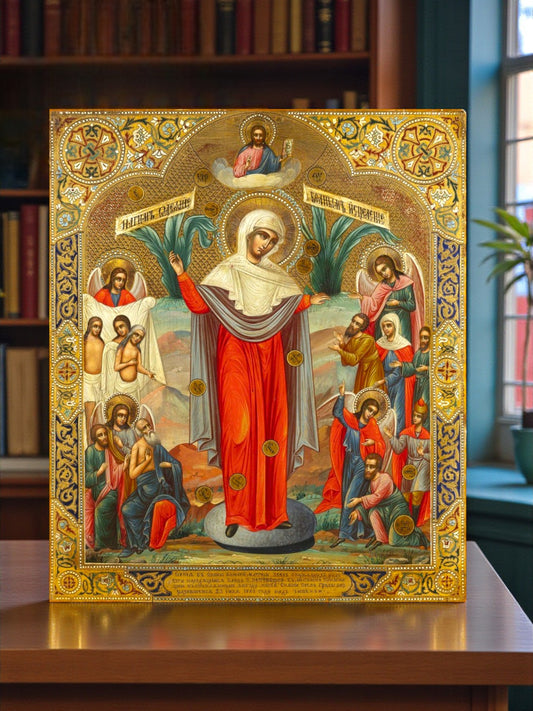
Saint Gregory the Great (Gregory the Dialogist) — Orthodox Icon
Saint Gregory the Great, known in the Orthodox tradition as Saint Gregory the Dialogist, was Pope and Bishop of Rome from 590 to 604 and one of the great hierarchs, theologians and pastors of the ancient undivided Church.
This icon reproduces a remarkable Russian icon painted in 1502 by the workshop of Dionysius, one of the greatest masters of medieval Russian icon painting.
The original icon came from the Deesis tier of the iconostasis of the Cathedral of the Nativity of the Virgin at the Ferapontov Monastery and is now preserved in the State Russian Museum in St. Petersburg.
The combination of an ancient Western saint and one of the masterpieces of early 16th-century Russian iconography makes this image particularly significant.
Who Was Saint Gregory the Great?
Saint Gregory was born in Rome around AD 540 into a prominent Roman family.
He received an excellent education and initially pursued a public career, becoming prefect of Rome. Yet Gregory eventually abandoned secular office and chose a life devoted to God.
He transformed his family home on the Caelian Hill into a monastery dedicated to Saint Andrew and embraced the monastic life.
Gregory would have preferred to remain in monastic solitude, but the needs of the Church repeatedly drew him into public service.
He served as a papal representative in Constantinople, and in 590, following the death of Pope Pelagius II, Gregory was elected Bishop of Rome.
He served until his repose in 604.
Why Is He Called Gregory the Dialogist?
In Western Christianity he is generally known as Gregory the Great or Pope Gregory I.
Orthodox Christians also know him as Gregory the Dialogist — Gregory Dialogus.
This title derives from his famous work commonly known as the Dialogues, a collection concerning the lives and miracles of Italian saints and the spiritual life.
The work was composed in the form of a dialogue, giving rise to the name by which Gregory became particularly well known in the Christian East.
Thus:
Saint Gregory the Great
Saint Gregory the Dialogist
Pope Gregory I
Gregory Dialogus
all refer to the same 6th-century Bishop of Rome.
Saint Gregory and the Liturgy of the Presanctified Gifts
Saint Gregory the Dialogist occupies a particularly familiar place in Orthodox liturgical tradition because his name is traditionally associated with the Divine Liturgy of the Presanctified Gifts.
This solemn Lenten service is celebrated on certain weekdays during Great Lent, when the Eucharistic Gifts have been consecrated at an earlier Divine Liturgy.
In Orthodox service books and tradition, Saint Gregory is commonly named in connection with this liturgy.
For this reason, his name remains familiar to Orthodox Christians far beyond his historical role as Pope of Rome.
Pope Gregory I and the Ancient Church of Rome
Gregory lived during a profoundly difficult period in Western European history.
The political structures of the old Roman world were collapsing, Italy had suffered warfare and disease, and Rome itself faced insecurity and poverty.
As Bishop of Rome, Gregory combined theological leadership with practical pastoral care. He organized assistance for the poor, administered Church lands, corresponded with bishops and rulers across Europe, worked to strengthen ecclesiastical discipline, and devoted considerable attention to missionary activity.
His surviving correspondence provides an extraordinary picture of Christian life around the Mediterranean and Western Europe at the end of the 6th century.
Saint Gregory and the Mission to England
One of the most important events associated with Gregory's pontificate was the mission to the Anglo-Saxons in England.
In 596, Gregory sent a group of monks led by Saint Augustine of Canterbury to preach Christianity in the Anglo-Saxon Kingdom of Kent.
The mission became a major milestone in the Christian history of England.
For this reason, Saint Gregory is connected not only with ancient Rome but also with the history of the Western Orthodox saints of Britain.
His missionary vision helped establish a Christian tradition that would produce generations of English saints during the centuries before the Great Schism.
The Writings of Saint Gregory the Great
Saint Gregory was one of the most influential Christian writers of the early Middle Ages.
Among his best-known works are:
Dialogues — accounts of Italian saints, miracles and spiritual life.
Pastoral Rule (Regula Pastoralis) — a profound work on the responsibilities and spiritual life of bishops and pastors.
Moralia in Job — an extensive theological and spiritual commentary on the Book of Job.
His sermons, letters and biblical commentaries also had enormous influence throughout medieval Christianity.
The Pastoral Rule in particular became one of the foundational texts concerning Christian pastoral ministry.
Is Saint Gregory the Great an Orthodox Saint?
Yes. Saint Gregory the Great is a saint of the Orthodox Church.
He lived from approximately 540 to 604, more than four centuries before the Great Schism of 1054, when the Church of Rome remained in communion with the Christian East.
Orthodox Christianity remembers him as Saint Gregory the Dialogist, Pope of Rome, honoring his pastoral life, theological writings and holiness.
His feast is celebrated in the Orthodox Church on March 12.
Saint Gregory is therefore one of the most important examples of a Western Orthodox saint — a great Bishop of ancient Rome belonging to the shared Christian heritage of the first millennium.
The Original Icon — Workshop of Dionysius, 1502
The historic original reproduced in this icon was created in 1502 in the workshop of Dionysius (Dionisy), one of the greatest Russian icon painters of the late 15th and early 16th centuries.
The icon originally belonged to the Deesis tier of the iconostasis of the Cathedral of the Nativity of the Virgin at the Ferapontov Monastery.
The Deesis is one of the central components of a traditional Orthodox iconostasis. Christ occupies the central position, while the Mother of God, Saint John the Baptist, apostles, hierarchs and other saints turn toward Him in prayer.
Saint Gregory's presence within this monumental ensemble emphasizes his place among the great holy hierarchs of the universal Church.
The original icon is now preserved in the State Russian Museum in St. Petersburg.
Dionysius and the Ferapontov Monastery
Dionysius, sometimes rendered in English as Dionisy, was one of the leading masters of medieval Russian sacred art and one of the most important figures in Russian icon painting after Andrei Rublev.
His artistic activity flourished around the turn of the 16th century.
Dionysius and his workshop are particularly associated with the Ferapontov Monastery, whose Cathedral of the Nativity of the Virgin preserves an extraordinary ensemble of frescoes created in 1502.
The icon of Saint Gregory the Dialogist belongs to this same artistic and spiritual world.
The refined proportions, solemn figure and harmonious character of the image are characteristic of the elevated artistic language associated with the Dionysian tradition of Russian icon painting.
Saint Gregory the Dialogist in Orthodox Iconography
Saint Gregory is depicted as a holy hierarch and Bishop of Rome.
His episcopal vestments identify his ministry within the Church, while the solemn and contemplative character of the image reflects his role as pastor, theologian and teacher.
Within the Deesis tier, however, the saint is not primarily presented as an individual historical portrait.
He belongs to the greater liturgical composition of the iconostasis, standing among the saints before Christ.
This context is particularly important for understanding the original 1502 icon: Saint Gregory is represented not simply as a famous Pope of Rome but as one of the holy bishops of the undivided Christian Church.
Gregory the Great, Gregory the Dialogist or Pope Gregory I?
All these names refer to the same saint.
Depending on the historical and Christian tradition, he may be called:
Saint Gregory the Great
St Gregory the Great
Saint Gregory the Dialogist
St Gregory the Dialogist
Gregory Dialogus
Pope Gregory I
Pope Gregory the Great
Saint Gregory I
Saint Gregory of Rome
Gregory the Great of Rome
In Russian Orthodox tradition he is known as Святитель Григорий Двоеслов, папа Римский.
The combination of these different names reflects his unusual importance to both the Christian East and West.
A Western Orthodox Saint in Russian Iconography
This icon beautifully illustrates the shared Christian heritage that existed long before the later division between Eastern and Western Christianity.
Its subject is a 6th-century Pope of Rome, while its artistic form comes from one of the greatest periods of medieval Russian Orthodox iconography.
More than nine centuries separate Saint Gregory's lifetime from the creation of the Ferapontov icon, yet Russian icon painters placed him among the great hierarchs of the Church.
For this reason, the icon is especially meaningful for those interested in Western Orthodox saints, the ancient Church of Rome, Russian iconography and the common Christian heritage of the first millennium.
Our reproduction is carefully produced on a prepared wooden panel and individually hand-finished with natural beeswax in our family workshop in Portugal.
Orthodox Feast Day: March 12.
Frequently Asked Questions
Who was Saint Gregory the Dialogist?
Saint Gregory the Dialogist is Saint Gregory the Great, Pope Gregory I of Rome, who served as Bishop of Rome from 590 to 604.
Why is Gregory the Great called “the Dialogist”?
The Orthodox title comes from his work known as the Dialogues, which recounts the lives and miracles of Italian saints in dialogue form.
Is Pope Gregory the Great an Orthodox saint?
Yes. Saint Gregory lived centuries before the Great Schism and is venerated in the Orthodox Church as Saint Gregory the Dialogist, Pope of Rome.
What is Saint Gregory's connection with the Presanctified Liturgy?
Orthodox liturgical tradition associates his name with the Liturgy of the Presanctified Gifts, celebrated during Great Lent.
Who painted the original Saint Gregory icon?
The original dates to 1502 and is attributed to the workshop of Dionysius, the celebrated master of medieval Russian icon painting.
Where did the original icon come from?
It belonged to the Deesis tier of the Cathedral of the Nativity of the Virgin at Ferapontov Monastery.
Where is the original icon today?
It is preserved in the State Russian Museum in St. Petersburg.
🖼 Product Features
Each icon in our workshop is made to last a lifetime and beyond. The image is printed with rich, fade-resistant pigment inks on a premium solid-core wood panel — then hand-finished with a natural beeswax coating that deepens the colors, protects the surface, and gives each piece the warm, reverent quality of a traditionally crafted sacred object. A metal hanging hook is included on the back, so your icon is ready to display the moment it arrives.
- Crafted on a premium wood panel — 1.6 cm (0.6") thick, sturdy yet lightweight
- Fade-resistant pigment print — rich, true-to-life colors that last for generations
- Natural beeswax finish — hand-applied for depth, protection, and a traditional feel
- Ready to hang — metal hook pre-attached on the reverse
- Hand-finished by Orthodox Christian artisans in Portugal
📏 Size: 14x30 cm (6"x12")
🎁 Perfect For
• Meaningful Orthodox Christian gifts
• Housewarming and family blessings
• Prayer corners and devotional spaces
• Baptisms, name days, weddings, and feast days
🌍 Worldwide Delivery
Securely packed and shipped worldwide from Portugal with tracking.
✨ Crafted with Tradition
Each icon is carefully made by Orthodox Christian artisans in Portugal — created to become a lasting blessing for your home or a treasured gift for someone you love.