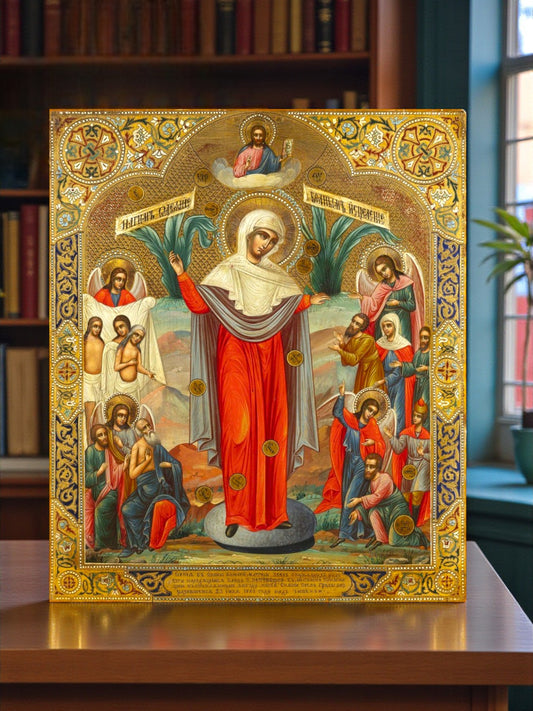
Stand before one of the most terrifying, magnificent, and spiritually urgent paintings ever created — The Triumph of Death by Pieter Bruegel the Elder, painted around 1562 and now permanently housed in the Museo del Prado, Madrid. This panel painting is a piece with a profound moral message, showing the triumph of death over all worldly objects and ambitions — symbolized through a vast army of skeletons devastating the earth. In the foreground, Death leads its armies on horseback, destroying the world of the living, who are driven toward a huge coffin-shaped trap with no hope of salvation. Every social class is included in the composition; there is no hope of being saved by power or devotion.
This is not merely a painting. It is a sermon in oil — the most comprehensive, unflinching, and artistically dazzling visual meditation on human mortality ever committed to panel. It is a work that the Christian faith has always needed: a mirror held up to the vanity of earthly life, an apocalyptic wake-up call, and ultimately — for those with eyes of faith — a profound invitation to seek the only life that death cannot touch.
Pieter Bruegel the Elder — Prophet with a Paintbrush
Pieter Bruegel the Elder was a Northern Renaissance artist, believed to have been born in the Netherlands around 1525–1530. He painted mythological and Biblical subject matter, but became renowned for painting everyday people — usually peasants — and vast, panoramic landscapes that seem to contain entire worlds within a single frame.
Painted in 1562 during a tumultuous period marked by war, famine, and disease, The Triumph of Death stands as a haunting testament to Bruegel's ability to capture the intricacies of the human condition — confronting viewers with the unsettling yet universal truth of mortality, inviting us to consider our own finitude and the impermanence of all worldly pursuits.
Bruegel lived at a time characterized by intense political, social, and religious upheaval in 16th-century Europe. The Protestant Reformation challenged the Catholic Church's authority, and religious conflicts involving the persecution of minorities occurred throughout this period. Europe had also been devastated by various wars, and the memory of the Black Death of 1348 still haunted the cultural imagination.
The work was probably commissioned as part of a series alongside two other paintings: Dulle Griet of 1563 and The Fall of the Rebel Angels of 1562 — three works similar in size and united by their apocalyptic, moralizing vision.
The Historical Roots: Danse Macabre and the Triumphs of Death
Bruegel fuses two established iconographic traditions: the Italian tradition of the Triumphs of Death, with works such as the fresco in Palermo dating from 1446, which the painter had the opportunity to visit during his trip to Italy; and the Nordic iconographic tradition of the Danse Macabre — the Dance of Death.
The Triumph of Death is a macabre iconographic theme with a moralizing intent that was common in Medieval literature and art. These subjects became widespread in the late Middle Ages and were even more in vogue after the Black Death of 1348, as a representation of the terrible collective experience of plague — and as a constant reminder to the living: Memento Mori — Remember that you will die.
Detailed Analysis: Scene by Scene Through the Apocalypse
The painting shows a panorama of an army of skeletons wreaking havoc across a blackened, desolate landscape. Fires burn in the distance. The sea is littered with shipwrecks. A few leafless trees stud hills otherwise bare of vegetation. Fish lie rotting on the shores of a corpse-choked pond. Art historian James Snyder describes it as a "scorched, barren earth, devoid of any life as far as the eye can see." In this hellish setting, legions of skeletons advance on the living from every direction.
🏇 Death on Horseback — The Central Figure The larger narrative shows Death in the form of a skeleton riding on a pale horse through the middle-ground, leading an army of executioners to bombard and kill the masses of humanity. This emaciated rider is a direct reference to the Fourth Horseman of the Apocalypse from the Book of Revelation — the rider whose name is Death, and Hell follows close behind him.
👑 The King — Power Cannot Save You A dying king's barrels of gold and silver coins are looted by a skeleton, while another skeleton holds up an empty hourglass to warn him that his time is running out. The mightiest throne in the world offers no protection. The juxtaposition of opulent castles and humble huts illustrates the egalitarian nature of death — sparing neither the powerful nor the powerless.
⛪ The Cardinal — Religion Cannot Exempt You Just beside the king, a cardinal is helped toward his fate by a skeleton who mockingly wears the cardinal's red hat. Even the highest office of the Church provides no special immunity. The red hat — symbol of authority, dignity, and the willingness to shed one's blood for the faith — is worn now by Death itself as a grotesque trophy.
🪄 The Coffin Trap — The Door from Which None Return The living are driven toward a huge casket — a coffin-shaped enclosure — with no hope of salvation. People are herded into this coffin-shaped trap decorated with crosses, while a skeleton on horseback kills them with a scythe. The crosses on the trap are deeply ambiguous — are they the sign of Christ's victory over death, or a cruel parody? Bruegel leaves the question open, forcing the viewer to supply their own answer from the depths of their faith or despair.
⏳ The Hourglass and the Scissors — Time Running Out A woman has fallen in the path of the death cart — holding in her hand a slender thread about to be cut by the scissors in her other hand, Bruegel's interpretation of Atropos, the Greek Fate who cuts the thread of life. Nearby, another woman holds a spindle and distaff — classical symbols of the fragility of human life. The extinguished candle, the broken hourglass, and the neglected instruments all symbolize the cessation of earthly pleasures and the stopping of time's flow.
🎵 The Lovers — Even Love Cannot Stop Death A couple can be seen playing music and singing in the lower right corner, seemingly unaware of their impending doom — a skeleton standing behind them playing along to their music. This is perhaps the most heartbreaking scene in the entire painting: two human beings lost in the tender world of music and love, entirely oblivious to the skeleton that accompanies their song. Beauty, romance, and art — the highest things of this world — offer no shelter from the final reckoning.
🐕 The Mother and Child — The Innocent Fall Too A starving dog nibbles at the face of a dead child lying still within its dead mother's embrace. No innocence is spared. No love is sufficient to hold back the tide. This single detail, more than any other in the painting, drives home the painting's most devastating theological question: Where is God in this?
🎺 The Skeleton Trumpeters — The Last Trumpet Scattered throughout the composition are groups of skeletons blowing trumpets — part of this deathly army that has come to destroy all life and usher the living to their deaths. For Christian viewers, these trumpets inevitably evoke the trumpets of the Apocalypse from the Book of Revelation — the final cosmic fanfare that announces the end of the old order and the beginning of the eternal.
🌳 The Barren Landscape — Creation Unmade In the upper left corner, skeletons ring the bell that signifies the death knell of the world. The horizon is blurred with smoke from villages on fire. The entire natural order — sea, land, sky, forest — has been stripped of life and beauty. This is creation in reverse: not the six days of Genesis building toward life, but a single terrifying hour reducing all things to ash and bone.
✝️ The Cross at the Center Almost hidden in the chaos, a cross sits in the center of the painting — silent, still, and undefeated. For the Christian eye, this is the painting's single point of theological hope: the Cross of Christ, standing in the very midst of death's greatest triumph, unmoved and unmovable. Death may reign for a season — but the Cross declares that its reign will end.
The Painting's Theological Message — A Christian Reading
The Triumph of Death is, at its deepest level, a profoundly Christian work — a visual Memento Mori of staggering ambition and moral power. Its message speaks directly to the heart of the Gospel:
The entire composition is a warning that there is no power, social class, or devotion that can save humans from the fate of biological death — the king, the cardinal, the soldier, the lover, the mother, the child: all fall equally before the army of skeletons. Bruegel strips away every human illusion of security and permanence with surgical precision.
Yet for the Christian believer, this is not the last word. The painting's terror is precisely the first word — the Memento Mori that clears the ground for the Gospel. If death triumphs over everything earthly, then the only rational response is to seek what death cannot touch: not gold, not power, not earthly love, not even religious office — but the living God who conquered death at Easter morning.
Bruegel portrays people from all walks of life and religious backgrounds surrendering to the power of death — suggesting that religious wars and earthly conflicts are ultimately futile, as they lead all to their deaths regardless of their beliefs. The painting is thus a devastating critique of every human attempt to use religion as a tool of earthly power — and a call to return to the only thing that matters: a living, personal relationship with the God who is stronger than death.
What Do Christians Pray for Before This Sacred Image?
While The Triumph of Death is not a traditional devotional icon, it has served as a profound focus of Christian meditation and prayer across the centuries. Before this image, the faithful are moved to pray for:
- ⏳ Wisdom to number our days — "Teach us to number our days, that we may gain a heart of wisdom" (Psalm 90:12); this painting strips away every distraction and forces the soul to face its own mortality
- 🕊️ A holy and prepared death — the painting shows those taken by death utterly unprepared; Christians pray to be found ready, shriven, and at peace when their hour comes
- 💰 Freedom from attachment to wealth and earthly power — the king's gold avails him nothing; this image is a powerful companion for prayers of detachment and simplicity
- 🙏 Conversion of heart before it is too late — the lovers in the corner do not notice death approaching; this image awakens the soul to the urgency of repentance and conversion now
- ✝️ Faith in the Resurrection — the Cross at the center of the chaos is the believer's anchor; Christians pray before this image for an unshakeable trust that Christ's victory over death is real and final
- 🌍 Peace in times of war, plague, and social collapse — Bruegel painted this in an era of religious war and epidemic; it accompanies prayers for the protection of nations, families, and the vulnerable in times of crisis
- 👼 The souls of the departed — before this image the faithful are moved to pray urgently for those who have died, that God's mercy may be greater than their sins
- 🔔 Vigilance in the spiritual life — the skeleton trumpeters sound their call; this image awakens the soul to the serious business of living each day in the light of eternity
🖼 Product Features
Each icon in our workshop is made to last a lifetime and beyond. The image is printed with rich, fade-resistant pigment inks on a premium solid-core wood panel — then hand-finished with a natural beeswax coating that deepens the colors, protects the surface, and gives each piece the warm, reverent quality of a traditionally crafted sacred object. A metal hanging hook is included on the back, so your icon is ready to display the moment it arrives.
- Crafted on a premium wood panel — 1.6 cm (0.6") thick, sturdy yet lightweight
- Fade-resistant pigment print — rich, true-to-life colors that last for generations
- Natural beeswax finish — hand-applied for depth, protection, and a traditional feel
- Ready to hang — metal hook pre-attached on the reverse
- Hand-finished by Orthodox Christian artisans in Portugal