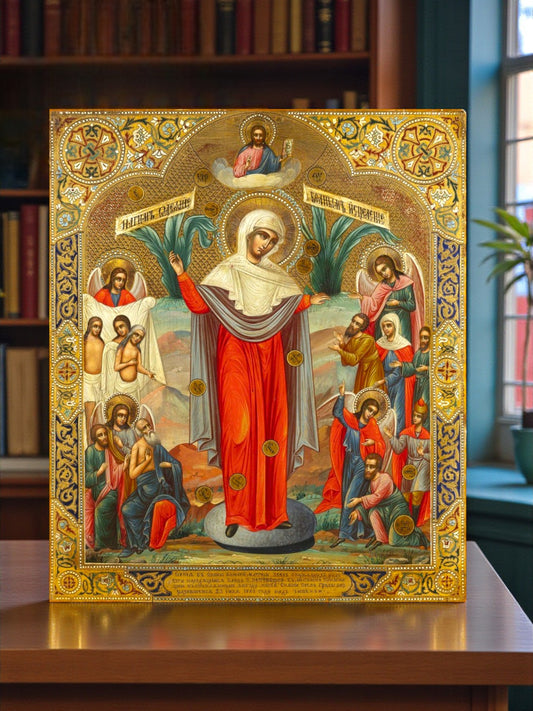
Contemplate one of the most intimate, consoling, and humanly moving scenes in the entire Old Testament — the Holy Prophet Elijah in the Desert, resting under the juniper tree, visited by the Angel of God, fed with bread and water from Heaven, and gently commanded: "Arise and eat, for the journey is too great for thee." This icon depicts not the triumphant Elijah of Mount Carmel who called down fire from Heaven — but the exhausted, broken, utterly spent Elijah who collapsed in the wilderness and asked God to let him die.
The Prophet Elijah is unique in Orthodox Christian tradition in that he is the only Old Testament figure to receive detailed individual treatment on icons. His partial yet intense experience of the divine in the cave at Mount Horeb would forever hold a central place in Orthodox spirituality. This is the icon of the God who does not abandon His servants in their darkest hour — but sends His angel to feed them, rest them, and prepare them for what comes next.
The Biblical Event: Elijah's Collapse in the Wilderness
The scene depicted in this icon is drawn from one of the most profoundly human passages in all of Holy Scripture — 1 Kings 19:1–18.
The Prophet Elijah fled into the Kingdom of Judea, and grieving over his failure to eradicate idol worship, he asked God to let him die. After the supreme triumph of Mount Carmel — where he had single-handedly called down fire from Heaven before all Israel and slaughtered the false prophets of Baal — the furious Queen Jezebel issued a death threat that shattered his courage completely. The man who had stared down an entire apostate nation was now fleeing in terror from one woman's threat.
Elijah fled to Beersheba in Judah, continued alone into the wilderness, and finally sat down under a shrub, praying for death and eventually falling asleep. His prayer was the prayer of utter human exhaustion — not of unbelief, but of a soul that has given everything and has nothing left: "It is enough; now, O Lord, take away my life; for I am no better than my fathers." (1 Kings 19:4)
The Angel's Touch: "Arise and Eat"
At length an angel of the Lord roused him gently, telling him to wake up and eat. When he awakened he found bread and a jar of water, ate, drank, and went back to sleep. The angel then came to him a second time, telling him to eat and drink afresh, because he had a long journey ahead of him.
The angel said to him: "Arise and eat; because the journey is too great for thee." He arose and found a cake and a cruse of water. Having partaken of the provision, he went forward on his way for forty days to Horeb, where he took residence in a cave.
Notice the extraordinary tenderness of this divine response. Elijah asked for death — and God sent him bread. He asked to be finished — and God said his journey was not yet over. He reached the absolute bottom of his human resources — and found that at the bottom, an angel was waiting with food, water, and a gentle hand on the shoulder. This is one of the most beautiful images of divine compassion in all of Sacred Scripture: a God who does not rebuke His exhausted servant, does not demand that he get up and be strong, but simply feeds him, lets him sleep, and feeds him again.
The Cave at Mount Horeb: The Still Small Voice
Elijah ate and drank, then traveled forty days and nights to Mount Sinai without eating along the way. There, he stayed in a cave, and God spoke to him. First, a powerful wind came, but God was not in the wind. Then an earthquake, but God was not in the earthquake. Then fire, but God was not in the fire. Finally, a gentle breeze — and God was present.
The iconography of the Prophet Elijah combines symbolic elements that reflect his importance. One of the most important stories depicted is his life in the cave on Mount Horeb. Almost all Elijah icons preserve the main motif of this event — the prophet in the desert or cave, sustained by divine providence.
This is the supreme mystical teaching of the Elijah story: God is not found in the earthquake of crisis, the fire of triumph, or the great wind of extraordinary events — but in the still small voice — the voice that speaks only when the soul is quiet enough to hear it. The desert is not punishment; it is the classroom of divine intimacy.
The Iconographic Tradition: Reading the Icon
The prophet must be portrayed according to a strict iconographical canon, summed up by Dionysius of Fourna, author of the eighteenth-century manual on icon painting: Elijah should be presented as an old man with a white beard. There should be a cave with the prophet sitting inside it; he rests his chin and leans his elbow on his knee. Above the cave, a raven watches him and carries bread in its beak.
Every element of the traditional icon speaks its own language of spiritual meaning:
🌿 The Juniper Tree or Wilderness Setting — The Desert as Sacred Space The barren wilderness in which Elijah collapses is not merely a geographical location — it is the sacred space of encounter between the exhausted human soul and the living God. For the icon maker, it is the cave — that most sacred space in Orthodox iconography, reserved only for the most important events in Christ's life, such as His birth at Bethlehem — that becomes the vessel of Elijah's most intimate encounter with the divine. The desert strips away everything that is not God, and in that stripping, God is found.
👼 The Angel — The Tenderness of Divine Providence The Angel of the Lord who appears to Elijah is shown in the icon with extraordinary gentleness — touching the sleeping prophet, presenting the bread and water, not demanding or commanding, but inviting. The icon maker incorporates the episode of Elijah fed by the raven into the scene of his abandonment in the wilderness, and hints at a mystical and reassuring encounter with the divine in the cave in which he seeks refuge. The angel's gesture of offering food is the gesture of God's infinite patience with human weakness.
🍞 The Bread and Water — The Eucharistic Foreshadowing The bread baked over hot coals and the jar of water that the angel provides to Elijah are among the most theologically charged objects in the entire Old Testament. The context for this image is the altarpiece below which the Eucharist is celebrated, thus highlighting the typological significance of Elijah's bread from heaven — the bread that prefigures the Bread of Life, the Eucharist given by Christ to sustain His Church on its long journey through history. The bread that sustained Elijah for forty days and forty nights to the mountain of God is the same divine nourishment that the faithful receive in the Eucharist for their journey to eternity.
🐦 The Raven — Unexpected Channels of Grace At God's command, Elijah hid in the cave at Mount Horeb, where ravens brought him bread every morning and meat every evening, and he drank water from the brook. The ravens — unclean birds in Jewish law, symbols of darkness and death — are chosen by God as His messengers of life and sustenance. This is God's characteristic irony: He provides for His servants through the most unlikely instruments, teaching them to trust not in the predictability of human provision but in the sovereign freedom of divine grace.
⛰️ Mount Horeb — The Mountain of Encounter Elijah travels for forty days and forty nights to Mount Horeb, where Moses had received the Ten Commandments. Elijah is the only person described in the Bible as returning to Horeb after Moses and his generation had left Horeb several centuries before. By going to Horeb, Elijah is placing himself in the footsteps of the great lawgiver, returning to the very ground where God first revealed His name — the ground of absolute divine encounter. The mountain is not a place of escape, but of commissioning: Elijah arrives exhausted and leaves renewed, with new tasks and the certain knowledge that he is not alone.
The Deeper Spiritual Teaching: God Meets Us at the Bottom
The icon of Elijah in the Desert is a theological masterpiece of consolation. Its central teaching is breathtaking in its simplicity and its mercy: God does not abandon His servants when they collapse. He feeds them, lets them rest, and sends them on.
The iconography of the Prophet Elijah encloses a symbolism of the all-seeing eye of the Lord — the icon reminds the faithful that God sees His servant even in the most desolate wilderness, and that no depth of exhaustion, despair, or spiritual desolation is beyond the reach of His tender care.
Elijah's collapse under the juniper tree has been recognized across the centuries as one of the most honest portraits of human spiritual burnout in all of sacred literature — a great man of God, at the end of his strength, asking to die. And God's response is not rebuke, not theological lecture, not even consolation — it is simply: bread, water, rest, and the gentle touch of an angel's hand.
According to the Tradition of Holy Church, the Prophet Elijah will be the Forerunner of the Dread Second Coming of Christ. He will proclaim the truth of Christ, urge all to repentance, and will be slain by the Antichrist. The man who collapses in despair in the desert will be the herald of the end of time. God does not waste His broken servants — He restores them.
What Do Christians Pray for Before This Icon?
The icon of Elijah in the Desert speaks with particular power to the modern believer — overwhelmed, burned-out, discouraged, and depleted. Before this sacred image, the faithful pray for:
- 😔 Comfort in depression, burnout, and spiritual exhaustion — Elijah's prayer "It is enough, Lord, let me die" is recognized by every soul that has reached its limit; this icon proclaims that God meets us precisely there, with bread, rest, and a gentle hand
- 🍞 Daily sustenance and God's provision in impossible circumstances — the bread and water from Heaven that sustained Elijah for forty days is the model for trusting God's provision when human resources have run completely dry
- 🙏 Renewal of the vocation and calling — Elijah was sent back, restored, and recommissioned; those who have lost their sense of purpose or calling pray before this icon for the same renewal
- 🏥 Healing of physical, mental, and emotional exhaustion — the angel's care was first of all physical — food, water, rest; this icon accompanies prayers for those suffering from illness, exhaustion, and the wounds of overextension
- 💔 Strength after great failure or disappointment — Elijah fled not from defeat but from victory — the darkness after a great success is one of the most dangerous spiritual moments; this icon is the companion of souls experiencing that particular desolation
- 🕊️ The grace to hear God's still small voice — in the cave at Horeb, God was not in the wind, earthquake, or fire, but in the gentle whisper; this icon accompanies prayers for interior silence, contemplation, and sensitivity to God's quiet movements
- 🌿 Protection of hermits, monastics, and those in solitude — Elijah is the father of all who seek God in the wilderness; those living contemplative and solitary lives invoke his powerful intercession
- 🌧️ Rain and deliverance from drought — as Elijah's prayer ended the three-year drought, farmers and communities in times of drought invoke him before this icon for God's mercy upon the earth
- ✝️ Perseverance in the spiritual life — the forty-day journey to Horeb sustained by a single meal of angelic bread is the image of the Christian life: one act of divine sustenance carries the soul further than it could ever imagine possible
🖼 Product Features
Each icon in our workshop is made to last a lifetime and beyond. The image is printed with rich, fade-resistant pigment inks on a premium solid-core wood panel — then hand-finished with a natural beeswax coating that deepens the colors, protects the surface, and gives each piece the warm, reverent quality of a traditionally crafted sacred object. A metal hanging hook is included on the back, so your icon is ready to display the moment it arrives.
- Crafted on a premium wood panel — 1.6 cm (0.6") thick, sturdy yet lightweight
- Fade-resistant pigment print — rich, true-to-life colors that last for generations
- Natural beeswax finish — hand-applied for depth, protection, and a traditional feel
- Ready to hang — metal hook pre-attached on the reverse
- Hand-finished by Orthodox Christian artisans in Portugal