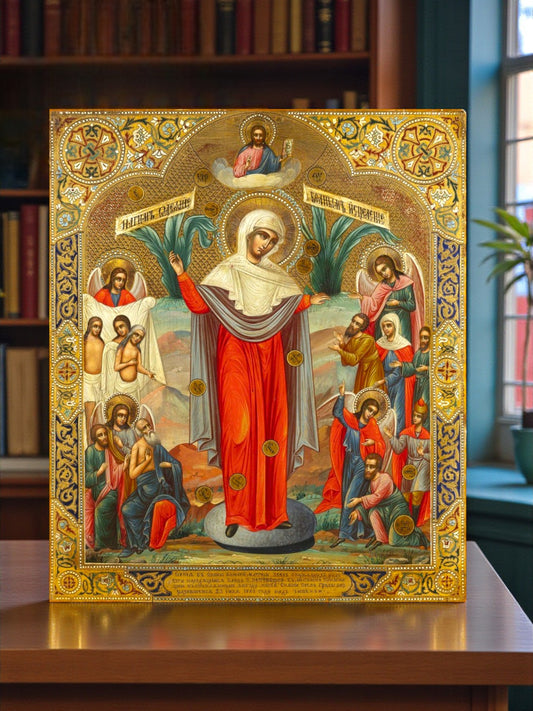
Behold one of the most theologically rich and liturgically profound icons in the entire Russian Orthodox tradition — the Savior Not Made by Hands with the Morning Gospel Stichera of the Octoechos — a remarkable composite sacred image uniting two of the most ancient and beloved treasures of Eastern Christian worship: the miraculous face of Christ imprinted on the cloth for King Abgar, and the eleven luminous Resurrectional hymns of Sunday Matins that have echoed through Orthodox churches every Lord's Day since the ninth century.
This icon is not simply a sacred image for individual prayer — it is a portable liturgical cosmos, a painted synopsis of the entire Sunday worship of the Orthodox Church, in which the central mystery of the faith — Christ's face given to the world by God Himself — shines at the center of the Church's most solemn morning hymns of the Resurrection.
The Central Image: The Savior Not Made by Hands
At the heart of this icon reigns the most ancient and sacred image in all of Christianity — the Acheiropoietos, the Image Not Made by Human Hands, known in Greek as the Mandylion and in Russian as Spas Nerukotvorniy.
The Icon of the Savior, Image Not-Made-by-Hands, is one of the earliest icons witnessed to by the Church. During the time of the earthly ministry of the Savior, Abgar, ruler in the Syrian city of Edessa, was afflicted with leprosy. Reports of the great miracles performed by the Lord extended throughout Syria and as far as Arabia. Although not having seen the Lord, Abgar believed in Him as the Son of God and wrote a letter requesting Christ to come and heal him, sending his court-painter Ananias to paint an image of the Divine Teacher.
After this, the Lord called for water and a towel. He wiped His face, rubbing with the towel, and on it was impressed His Divine Image. The towel and the letter the Savior sent with Ananias to Edessa. With thanksgiving Abgar received the sacred object and received healing. Having written on the Image Not-Made-By-Hands the words "Christ-God, everyone trusting in Thee will not be put to shame," Abgar adorned it and placed it in a niche over the city gates.
In the time of the iconoclastic heresy, the defenders of icon-veneration, shedding their blood for the Holy Icons, sang the Troparion to the Image Not-Made-By-Hands. The Image of the Holy Face was put up as an emblem of the Russian armies, defending them from the enemy; and in the Russian Orthodox Church there is a pious custom that before entering a church, the faithful read together the prayers and the Troparion to the Image Not-Made-By-Hands.
The face of Christ at the center of this icon is therefore no ordinary image — it is the self-portrait of God Incarnate, the foundation of all Christian iconography, and the supreme answer to every doubt about whether the Eternal can be depicted in paint and gold.
The Border Panels: The Morning Gospel Stichera of the Octoechos
Surrounding the central image of the Holy Face, arranged in the border panels of the icon, are scenes illustrating the eleven Morning Gospel Stichera — known in Greek as the Heothina (ἑωθινά — "dawn hymns") — the eleven resurrectional hymns of Sunday Matins from the Octoechos, the great liturgical book of the eight tones.
What Are the Morning Gospel Stichera?
The eleven stichera of the Heothina are ascribed to the Emperor Leo VI and are sung in connection with the Matins Gospel during Orthros (Sunday Matins). The first eight follow the Octoechos order of the eight tones.
On Sundays, the Matins Gospel is read at the Holy Table (altar), which symbolizes the Tomb of Christ. The priest does not hold the Gospel Book during the reading, but reads it as it lies open on the Holy Table. Immediately after the reading, the priest kisses the Gospel Book and hands it to the deacon who brings it out through the Holy Doors and stands on the ambon, holding the Gospel aloft for all to see, while the choir chants the Hymn of the Resurrection: "Having beheld the Resurrection of Christ, let us worship the holy Lord Jesus, the only sinless one."
The most ancient material in the Octoechos originated in Jerusalem and focuses on the Sunday celebration of the Resurrection. This material includes the resurrectional stichera sung at "Lord, I call..." and the stichera sung at the Praises of Sunday Matins. In fact, the title Octoechos originally applied only to this Sunday resurrectional material.
Each of the eleven Heothina stichera corresponds to one of the eleven Sunday Gospel accounts of the Resurrection appearances of Christ — the eleven moments in which the Risen Lord revealed Himself to His disciples after the Tomb was found empty. Each hymn meditates on a different aspect of the Resurrection mystery: the myrrh-bearing women at the tomb, the appearance to Mary Magdalene, the encounter on the road to Emmaus, the appearance to the Apostles in the upper room, the encounter with Thomas, the appearance at the Sea of Tiberias, the Great Commission, and more.
What Does the Octoechos Mean?
The weekly cycle of feasts is contained in the liturgical book called the Great Octoechos — Book of the Eight Tones — or Parakletike. The Octoechos is structured on a recurring cycle of eight weeks, one for each of the eight tones of Orthodox ecclesiastical chant. The sequence begins on the Sunday after Pascha and ends on the final day of Great Lent in the following year. Each of the eight tones contains a set of variable elements for the daily service of the week, beginning with Sunday.
There are eight sets of Resurrectional hymns, corresponding to the eight tones, each of which concentrates on a different aspect of the Resurrection. The Resurrection, as the Feast of Feasts, has the greatest priority and generally the highest number of dedicated hymns and prayers.
The Octoechos's application in the lives of Orthodox Christians need not be complicated: every Sunday of the year, the Church returns to the Resurrection, singing its hymns in one of the eight tones, renewing the foundational experience of the faith — Christ is Risen — week after week, tone by tone, until the end of time.
Why Are These Two Combined in One Icon?
The union of the Savior Not Made by Hands with the Morning Gospel Stichera of the Octoechos is a uniquely Russian Orthodox iconographic tradition of profound theological intention. It is not an accidental combination — it is a visual theological statement of the highest order.
The Mandylion — the face of Christ imprinted on the cloth — is the image of the Incarnation: God entering matter, pressing His divine face into the fabric of the visible world, making Himself touchable, seeable, depictable. It declares: God has become man.
The Eleven Morning Gospel Stichera are the hymns of the Resurrection: eleven musical meditations on the eleven Gospel accounts of Christ risen from the dead, appearing to His disciples in the luminous hours after the empty tomb. They declare: The man who became God has conquered death.
Together they form a complete Gospel: the face that was born in Bethlehem, imprinted on a cloth for a dying king, crucified on Calvary, sealed in a tomb — is the same face that appeared in the garden on the morning of the third day. The Mandylion and the Heothina are two sides of one mystery: Incarnation and Resurrection, the Alpha and Omega of the entire Christian faith.
In the Russian tradition, this composite icon was particularly beloved as a church icon — placed in the iconostasis, venerated at Sunday Matins, and used as a visual synopsis of the entire Sunday liturgical cycle. The worshipper who stood before it was simultaneously venerating the holy face of Christ and meditating on the eleven Resurrection appearances that form the theological backbone of Sunday worship throughout the year.
The Liturgical Context: Sunday Matins in the Orthodox Church
Matins, or Orthros, is the service of morning prayer in the Orthodox Church that usually precedes and prepares the faithful for the Divine Liturgy. The Matins service offers both praise to God and instruction to the worshippers.
Sunday Matins is the longest of the regular Matins services, which can last up to three hours. It contains a combination of canons taken from the Octoechos, Menaion, Triodion, and Pentecostarion. Often this Matins is part of an all-night vigil, particularly in Slavic practice.
The eleven Sunday Gospel readings of Matins — the accounts of the Resurrection appearances — rotate in sequence throughout the year, so that over the course of the eight-week Octoechos cycle, the entire panorama of the Risen Christ's appearances is sung and heard by the faithful. The Morning Gospel Sticheron sung after each Gospel reading is the poetic, musical commentary on that particular Resurrection appearance — the Church's prayerful response to the good news just proclaimed.
On Icons of the Savior Not-Made-by-Hands, one should kiss the hair of Christ when venerating the icon — a unique liturgical rubric that speaks to the extraordinary holiness and intimacy of this sacred image.
Feast Day
The Feast of this Icon is celebrated on August 16, during the Afterfeast period of the Feast of the Dormition, and is popularly called the Third Feast-of-the-Savior in August. In Russian piety it is known as Spas na Polotne — the Savior on the Linen — the third and most mystical of the three August Feasts of the Savior, preceded by the Honey Savior (August 1) and the Apple Savior (August 6 — Transfiguration).
What Do Christians Pray for Before This Icon?
This composite icon — the Holy Face united with the eleven Resurrection hymns — is one of the most complete and theologically rich images in all of Russian Orthodox iconographic tradition. Before this sacred image, the faithful pray for:
- 🙏 Deepening of Sunday worship and liturgical prayer — this icon is the visual embodiment of Sunday Matins; those who pray before it are drawn into the full depth of the Church's weekly Resurrectional worship
- 🩺 Healing of illness — the Mandylion at its center is the supreme healing icon of the Christian tradition; it healed King Abgar of leprosy, and the faithful invoke it for every affliction of body and soul
- ✝️ Faith in the Resurrection — the eleven scenes of the Risen Christ surrounding the Holy Face are a visual catechism of the Resurrection; those struggling with doubt, grief, or despair find in this icon the certainty of the Risen Lord
- 🛡️ Protection of the home, city, and nation — the Icon Not-Made-by-Hands was put on the standards of the Russian army, defending them from the enemy; this composite icon carries that same protective power into the home and the heart
- 🎵 The grace of liturgical prayer and chanting — the Octoechos stichera are the greatest hymns of the Orthodox Sunday; musicians, chanters, choir directors, and all who love the Church's music pray before this icon for the grace to sing God's praises worthily
- 👁️ Contemplative encounter with the face of Christ — the central Mandylion invites the soul into wordless, imageless prayer before the face of God; this icon accompanies the deepest forms of hesychast and contemplative prayer
- 🌅 The grace of rising for morning prayer — the Heothina are the dawn hymns; those who struggle to pray in the morning invoke this icon for the grace of Elijah's angel: "Arise and eat — the journey is too great for you"
- 💔 Comfort for the bereaved — the Resurrection appearances depicted in the eleven stichera scenes are all encounters between Christ and those who loved Him and thought He was lost forever; the bereaved find in them the certain promise that all separations are temporary in the light of the Risen Lord
- ⛪ Renewal of parish and monastic life — as a liturgical icon par excellence, this image is the patron of every choir, every chanter, every priest and deacon who leads the Church in her Sunday morning praise
🖼 Product Features
Each icon in our workshop is made to last a lifetime and beyond. The image is printed with rich, fade-resistant pigment inks on a premium solid-core wood panel — then hand-finished with a natural beeswax coating that deepens the colors, protects the surface, and gives each piece the warm, reverent quality of a traditionally crafted sacred object. A metal hanging hook is included on the back, so your icon is ready to display the moment it arrives.
- Crafted on a premium wood panel — 1.6 cm (0.6") thick, sturdy yet lightweight
- Fade-resistant pigment print — rich, true-to-life colors that last for generations
- Natural beeswax finish — hand-applied for depth, protection, and a traditional feel
- Ready to hang — metal hook pre-attached on the reverse
- Hand-finished by Orthodox Christian artisans in Portugal