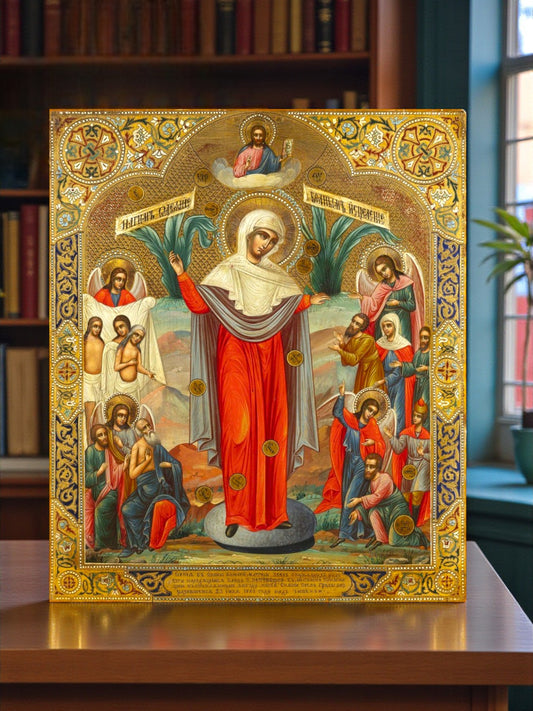
Saint Hilda of Whitby Icon — Anglo-Saxon Abbess and Spiritual Mother
Saint Hilda of Whitby (614–680), also known as St Hild of Whitby, was one of the most influential women of early English Christianity. An Anglo-Saxon princess who became a nun and abbess, she devoted her life to monastic leadership, Christian education and the spiritual formation of the Church in Northumbria.
She is especially remembered as the founding abbess of Whitby Abbey, the monastery associated with the historic Synod of Whitby in 664.
This Orthodox-style icon depicts Saint Hilda holding an abbess's staff, with a monastery and the surrounding landscape in the background — a reminder of her spiritual authority and the religious community she guided.
The Iconography of Saint Hilda of Whitby
Saint Hilda is portrayed as a monastic woman holding a staff, a traditional symbol of her responsibility as an abbess and spiritual guide.
Behind her stands a monastery surrounded by a peaceful landscape. The architecture recalls the early monastic community at Streoneshalh, the ancient name associated with Whitby, where Hilda established one of the most important religious centers of Anglo-Saxon England.
The landscape reflects the setting of her monastic life and the close relationship between the early English monasteries, prayer and learning.
Rather than depicting a particular miracle, this composition emphasizes Saint Hilda's wisdom, monastic leadership and dedication to the Christian community.
The Life of Saint Hilda — Abbess of Whitby
Born in 614 into the Northumbrian royal family, Hilda was baptized as a Christian in 627, during the mission of Saint Paulinus to Northumbria.
She later entered religious life and became an influential abbess, first leading a community at Hartlepool.
Around 657, she established the monastery at Whitby, known in her lifetime as Streoneshalh.
This was a double monastery, a religious community of both men and women living in separate houses under the authority of an abbess.
Hilda became renowned for her wisdom, learning and spiritual guidance. Several men educated within her community later became bishops, reflecting the monastery's importance in the development of the early English Church.
Saint Hilda and the Synod of Whitby
In 664, Hilda's monastery hosted the Synod of Whitby, one of the defining events in the history of Christianity in Anglo-Saxon England.
The gathering addressed differences in ecclesiastical practice, particularly the calculation of the date of Easter.
King Oswiu of Northumbria ultimately supported the Roman method of calculating Easter.
Although Hilda had been formed within the traditions associated with Iona, she accepted the decision and continued her work as abbess.
The synod remains an important event in the history of the English Church and its relationship with wider Western Christianity.
Saint Hilda and the Poet Cædmon
Saint Hilda is also closely associated with Cædmon, one of the earliest named poets in the English language.
According to the Venerable Bede's Ecclesiastical History of the English People, Cædmon was an ordinary worker at Hilda's monastery who received the gift of composing religious poetry.
Recognizing his ability, Hilda welcomed him into the monastic community and encouraged his religious education.
Through this story, Saint Hilda is remembered not only as a monastic leader but also as a patron of Christian learning and the development of early English literature.
Saint Hilda in Orthodox and Western Christianity
Saint Hilda lived in the seventh century, long before the formal separation of the Eastern and Western Churches.
She belongs to the shared Christian heritage of the first millennium and is honored among the Western saints venerated in Orthodox Christianity.
Her memory is also preserved in the Anglican and Catholic traditions.
Feast day: November 17, in several Western Christian calendars. Orthodox commemorations may differ according to jurisdiction and calendar.
Saint Hilda is particularly associated with Christian education, monastic life, spiritual guidance, wisdom and the history of Christianity in England.
Our Wooden Icon of Saint Hilda
This icon of Saint Hilda of Whitby is produced on a prepared wooden panel in our family workshop in Portugal.
The composition presents the saint with her abbess's staff, a monastery and a landscape inspired by the setting of her life in Northumbria.
Each icon is individually produced with detailed pigment printing and finished by hand with natural beeswax. The sides and back are also finished by hand.
A meaningful image for a home prayer corner, a church, a Christian school or as a gift for those devoted to Saint Hilda, Whitby Abbey, early English Christianity and the saints of Britain.
Frequently Asked Questions
Who was Saint Hilda of Whitby?
Saint Hilda (614–680) was an Anglo-Saxon abbess and spiritual leader who founded the monastery at Whitby and helped shape early Christianity in Northumbria.
Why is Saint Hilda depicted with a staff?
The staff represents her authority and pastoral responsibility as an abbess guiding a monastic community.
What monastery is associated with Saint Hilda?
Saint Hilda founded and led the monastery at Streoneshalh, traditionally identified with Whitby in North Yorkshire, England.
What happened at the Synod of Whitby?
In 664, church leaders met at Hilda's monastery to discuss differences in Christian practice, particularly the calculation of Easter. The king adopted the Roman method.
Is Saint Hilda an Orthodox saint?
Yes. Saint Hilda is honored among the saints of early Western Christianity recognized in Orthodox tradition.
When is Saint Hilda's feast day?
She is commonly commemorated on November 17 in Western Christian calendars, with some differences between churches.
🖼 Product Features
Each icon in our workshop is made to last a lifetime and beyond. The image is printed with rich, fade-resistant pigment inks on a premium solid-core wood panel — then hand-finished with a natural beeswax coating that deepens the colors, protects the surface, and gives each piece the warm, reverent quality of a traditionally crafted sacred object. A metal hanging hook is included on the back, so your icon is ready to display the moment it arrives.
- Crafted on a premium wood panel — 1.6 cm (0.6") thick, sturdy yet lightweight
- Fade-resistant pigment print — rich, true-to-life colors that last for generations
- Natural beeswax finish — hand-applied for depth, protection, and a traditional feel
- Ready to hang — metal hook pre-attached on the reverse
- Hand-finished by Orthodox Christian artisans in Portugal
📏 Available Sizes
• Small – 12 x 15 cm (5” x 6”)
• Medium – 23 x 30 cm (9” x 12”)
• Large – 30 x 39 cm (12” x 15”)
🎁 Perfect For
• Meaningful Orthodox Christian gifts
• Housewarming and family blessings
• Prayer corners and devotional spaces
• Baptisms, name days, weddings, and feast days
🌍 Worldwide Delivery
Securely packed and shipped worldwide from Portugal with tracking.
✨ Crafted with Tradition
Each icon is carefully made by Orthodox Christian artisans in Portugal — created to become a lasting blessing for your home or a treasured gift for someone you love.